“ Boola  Boola Boula In Fiji  Means “We’re Happy You’re Here, Welcome, We Love You “ explained  Marsha Vande Berg, President of MJGlobal Insight- July 2024

Boola, Boola, rang out the cry. Faces turned up in smiles even though not even the Americans among us understood the words’ meaning. That is unless they were Yale University graduates or citizens of Fiji! Boola, boola is the recurring verse of the Yale song sung worldwide by Yalies and Yalie fans. In Fiji, it’s repeated three times in a greeting – We’re happy you’re here; welcome – we love you. 

On this sunny day in 2000 as the China economy was just beginning to open up,  boola, boola was the cry of a smiling Chinese American, Billy Lee, who hailed originally from Ningpo and who gradated from Yale School of Architecture and is now retired in California , USA. On that sunny day, Billy was focused on performing in an impromptu skit before a small group of Chinese citizens in a village in Yunnan Province. Back in San Francisco, he and the five others in the traveling delegation, including this author, were members of The 1990 Institute and by extension, guests in this western, China province of the All China Women’s Federation. All but the author spoke Chinese. I dare say fewer in the audience seated on the outdoor folding chairs spoke English! 

But we were determined to communicate, and hence we performed a skit.

Our intent was pretty simple: extending friendship that is curious yet speaks without judgment of the other. We spoke different languages but we regarded the gathering as an opportunity to share a common embrace, a willingness to break bread with one another and to express gentle curiosity about each other’s way of life.  To this day, we value this experience as a gesture on behalf of cross-cultural friendship. It works when it can happen with an open heart and open hands. Its effect multiplies when it grasps the potential for bridging otherwise difficult times in geopolitics and between behemoth economies.

Boola, boola, boola became our collective chant back in 2000 in Yunnan Province. Going forward, we knew it pointed to a better way for realizing friendship that’s measured not in trade dollars or competitive economics but in smiles and a handshake or two. We realized too that the chant would unlock memories of friendship shared without judgment. Boola, boola! 

Marsha Vande Berg is president of MJGlobal Insights, a international corporate and non profit director and advisor. Find her at: linkedin.com/in/mjvb

“ Boola  Boola Boula In Fiji  Means “We’re Happy You’re Here, Welcome, We Love You “ explained  Marsha Vande Berg, President of MJGlobal Insight- July 2024

Boola, boola, rang out the cry. Faces turned up in smiles even though not even the Americans among us understood the words’ meaning. That is unless they were Yale University graduates or citizens of Fiji! Boola, boola is the recurring verse of the Yale song sung worldwide by Yalies and Yalie fans. In Fiji, it’s repeated three times in a greeting – We’re happy you’re here; welcome – we love you

On this sunny day in 2000 as the China economy was just beginning to open up,  boola, boola was the cry of a smiling Chinese American, Billy Lee, who hailed originally from Ningpo and who is now a successful architect in California whose work is recognized widely by many, not the least of whom I.M. Pei. On that sunny day, Billy was focused on performing in an impromptu skit before a small group of Chinese citizens in a village in Yunnan Province. Back in San Francisco, he and the five others in the traveling delegation, including this author, were members of the 1990 Institute and by extension, guests in this western, China province of the All China Women’s Federation. All but the author spoke Chinese. I dare say fewer in the audience seated on the outdoor folding chairs spoke English! 

But we were determined to communicate, and hence we performed a skit.

Our intent was pretty simple: extending friendship that is curious yet speaks without judgment of the other. We spoke different languages but we regarded the gathering as an opportunity to share a common embrace, a willingness to break bread with one another and to express gentle curiosity about each other’s way of life.  To this day, we value this experience as a gesture on behalf of cross-cultural friendship. It works when it can happen with an open heart and open hands. Its effect multiplies when it grasps the potential for bridging otherwise difficult times in geopolitics and between behemoth economies.

Boola, boola, boola became our collective chant back in 2000 in Yunnan Province. Going forward, we knew it pointed to a better way for realizing friendship that’s measured not in trade dollars or competitive economics but in smiles and a handshake or two. We realized too that the chant would unlock memories of friendship shared without judgment. Boola, boola! 

Marsha Vande Berg is president of MJGlobal Insights, a international corporate and non profit director and advisor. Find her at: linkedin.com/in/mjvb
Holistic Thinking As Succinctly As I Can by Stephen Lee – Key Words & Current Questions – July, 2024

What” is the Whole to think about?

The Wholest Whole is only limited by the ability of my imagination. The key definition is the boundary (if it exists) for including everything, and over all time. What is “everything” then … ? Holistic Thinking can be applied to a smaller Whole. But the conclusions we draw from that thinking will very likely have room for improvement when we look beyond the boundary.

An Example of Parts of one Incomplete Whole

The Universe

The Earth and All Living Things

Ethnic or Religious Groups Nations

Groups and Organizations of People

Families and Friends

Individuals

This is just one way to break the Whole into units, down to individual persons who interact over time with one another and the other parts of the Whole.

Smaller than the human size is the other direction for the boundary of the Whole to expand. Virus, nano particles, atoms, photons, Higgs particle? Invisible fields? Thoughts?

Consciousness? Free Will? Soul? “God”?

In addition to space and time as the dimensions to draw the boundary of the Whole, consider also the “dimension” consisting of the foundation assumptions of your belief system for truth and life purpose. What if some part of my belief system is different from that of another person?

Why Think in Full Consideration of the Whole?

What is your answer to this question? Our personal answer to this question is the best way to start a personal mental, emotional or spiritual journey. I leave this as an open question.

How to Think Holistically?

1. When a question (especially a serious one) comes to my mind and I want to make an evaluation or a decision about what to do next, and I have sufficient time to carefully and rationally consider the what, why, how and the possible consequences of the different paths which are open for me to choose, I would try to look at the Whole picture and consider the effects of each of my possible choices or decisions on the future paths of each of the parts of the Whole. When my choice affects another person, I need to consider what the effects are and how that person will react or choose to react. This is obviously an immense mental exercise and depending on the time available, a blend of personal rules of wisdom may need to be used. One technique is to think logically on all different parts of the question and then “sleep on it”. More ideas may pop up after our brain or our mind somehow connects the dots and then suggests some new ideas or an answer.

2. How do I know that I have found the best answer? When my mind finally can rest in peace and harmony with myself on this question. Recognizing that this is still my personal answer to my question, I accept it as a tentative solution, subject to personal lessons yet to be learned.

3. How and why we choose among the different paths ahead of us is the most difficult part of Holistic Thinking. It defines our individual wants in our own mind and in our estimation of others’ wants as well. Ultimately, if we think about what makes us happy about our whole life or what purpose, if any, we want to strive for in our life, this step of Holistic Thinking rounds out the Wholeness into a potential Unity in the Diversity of the Universe.

4. The most fatal mistake in critical or logical thinking is the False Dichotomy or the Excluded Middle (described by Carl Sagan in his Baloney Detection Kit). By casting a problem as a choice between black or white only, the argument promotes polarization. “If you are not with us, you are against us!”

5. For Holistic Thinking to be more complete, it is necessary to understand uncertainty, and learn how to make evaluation which considers uncertainty, especially when the uncertainty has a range of possibilities.

Some Key Words or Thoughts to Stimulate Holistic Thinking

● Interconnected ● Interdependence ● Working together ● See big picture ● Recognize patterns ● Parts working together for the Whole ● Cause and multiple Effects ● Multiple perspectives ● How to cut and share a Pie ● Is there a way to make everyone happy? ● What mode of interaction among the parts can make the Whole better?

Some Current Questions for Thinking Holistically

● Why is the behavior of my grandchildren so different from my own childhood behavior?

● Why has the influence of some religions declined?

● Why has Democracy in many countries become polarized or fragmented or appearing less ideal?

● Why global climate changes have not yet been taken up as an urgent world effort?

_______________________________________________________

Prof. Joe R Mcbride shares a joyful story about HOW TO DISCOVER, CAPTURE, &  MAINTAIN MEANINGFUL FRIENDSHIPS – Billy – July 2024

Billy  wrote on July 24

Dear Good Friends All, Just want to let you know that most of my time today is spent on peddling Friendshipology and Compassion This has been most Gratifying ! Love to have you write something for my <https://friendshipology.net> even as you may already have done so ? Cheers ! Billy – Ming Sing Lee

Instant reply from Prof. Joe Mcbride- U.C. Berkeley

Dear Billy,   Glad to hear from you as usual. Attached is something you might want to consider for your articles for Friendshipology.                                                                                           Stay well,                                                                                                          Joe

Maintaining & Rekindling a Friendship – by Joe McBride

Maintaining a friendship sometimes requires a special effort, especially when a friend is not close by. Zemin Wu is a friend of mine who lives in Hefei, China. I first met him on a trip with Billy Lee about 25 years ago to explore potential research projects that could improve the environments of cities in China. Zemin was teaching in Hefei at the time, and we immediately hit it off. Our friendship developed as we explored different urban forest designs that could reduce air pollution in the city of Hefei. Our contacts extended over a three-year period as I travelled to Hefei and Zemin came to California. Subsequently, our contact in person and via email diminished to annual email New Year greetings.

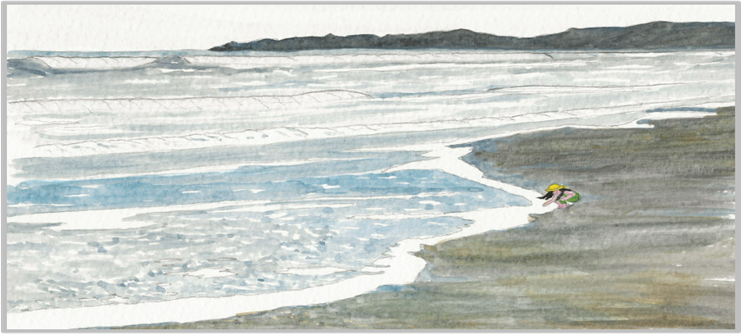
One year I added to my annual New Years email a watercolor sketch I had done to let him know that I had taken up watercolor sketching in my retirement.

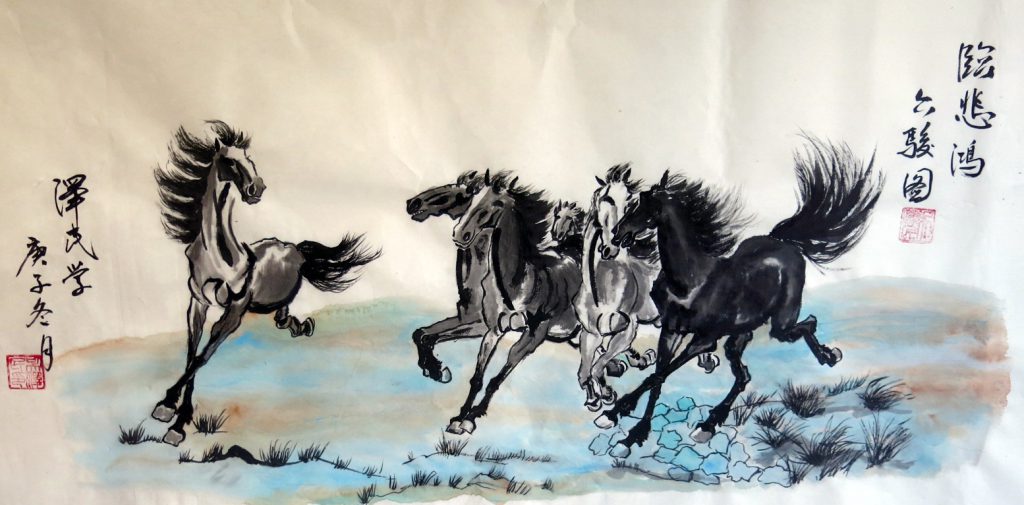
Zemin responded with an ink sketch of horses he had recently done.

Discovering a common interest in sketching rekindled our friendship. It was this mutual interest that
sustained and reinvigorated our friendship. If you have an old or distant friend, see if you can identify
a mutual interest that could rekindle the friendship.

__________________________________________________

Butterfly or Firefly: What’s Your Friendship Style? Take The Quiz – by Catherine Pearson – illustration by Anna Parini – NEW YORK TIMES – June 9,2024

An illustration of a person with a butterfly on their hand, a person holding flowers in front of their face, a person looking down at a jar with a firefly in it, and a person watering a small evergreen tree.

Welcome to Well’s 5-day Friendship Challenge! Step one is to discover your friendship style. Do you like to plumb the depths of a new acquaintance’s soul? Or are you surprisingly skilled at small talk? We all need so Welcome to Well’s 5-day Friendship Challenge! Step one is to discover your friendship style. Do you like to plumb the depths of a new acquaintance’s soul? Or are you surprisingly skilled at small talk? We all need social connection, but we thrive in different ways.

So we partnered with Kasley Killam, a social scientist and author of the new book “The Art and Science of Connection,” to develop this quiz

__________________________________________________________