ChatGPT: A well-run fraternity can provide benefits that are often difficult to obtain elsewhere. The key phrase is well-run—one that emphasizes character, friendship, service, learning, and lifelong connection rather than exclusivity or status.
Major Benefits
1. Lifelong Friendship
The deepest benefit is often enduring friendship.
- Friends who celebrate successes and support each other during difficulties.
- A sense of belonging during college and beyond.
- Intergenerational friendships spanning decades.
Example:
Members of Phi Beta Kappa Society or long-established university fraternities often report reconnecting with classmates 40–60 years later through reunions and alumni activities.
2. Learning How to Live With Others
A fraternity house can become a practical laboratory for citizenship.
Members learn:
- Cooperation
- Conflict resolution
- Shared responsibility
- Leadership
- Respect for diversity
Example:
Students sharing a house near Yale University or Stanford University must collectively manage budgets, meals, maintenance, and social events.
3. Leadership Development A healthy fraternity offers many leadership roles.
Members may serve as:
- President
- Treasurer
- Recruitment chair
- Service chair
- Alumni coordinator
These roles provide experience similar to managing a small nonprofit organization.
4. Professional Networks
Alumni networks can open doors. Benefits include:
- Career advice
- Internships
- Mentorship
- Business introductions
The greatest value often comes not from favoritism but from trusted relationships.
5. Service and Civic Engagement Many fraternities sponsor:
- Food drives
- Scholarship funds
- Community projects
- Volunteer programs
Members learn that leadership includes service.
6. Preservation of Traditions
Fraternities can become custodians of institutional memory. They preserve:
- Stories
- Songs
- Rituals
- Values
- Historical records
These traditions help create continuity between generations.
The Highest Benefit
A fraternity reaches its fullest potential when it evolves from:
Social Club → Community → Brotherhood/Sisterhood → Lifelong Circle of Care
At its best, a fraternity quietly answers three human needs:
- To belong
- To become
- To contribute
This might inspire a teaching poster:
A Good Fraternity
Not a ladder to climb.
A circle to belong to.
Not a network to use.
A community to serve.
Not a badge of status.
A lifelong practice of friendship.
The greatest fraternity does not ask: “How can this help me?”
It asks: “How can we help one another flourish?”
Yes. That small change actually shifts the philosophy in a profound way.
“How much did I grow?” still centers the individual.
“How much did we grow together?” recognizes that much of our growth comes through relationships, encouragement, challenges, examples, and shared experiences. It aligns beautifully with the spirit of fraternity, friendship, and community
The Measure Of Success
Not: “How high did I rise?” But: “How far did we grow together?”
Not: “How much did I gain?” But: “How much did we contribute together?”
Not: “How many honors did I receive?” But: “How many lives did we help enrich?”
Less about: How high I climbed. More about: How far we grew together.
Less about: What I gained. More about: What we contributed together.
Less about: Personal recognition. More about: Shared flourishing.
I especially like the phrase: ” How Far Did We Grow Together? “ because it contains three powerful ideas:
- Growth (continuous improvement)
- Togetherness (fraternity and friendship)
- Journey (lifelong development)
It also echoes many of the values you’ve been exploring in Friendshipology and the Age of Culture:
From competition to contribution.
From individual success to shared flourishing.
From achievement alone to growth together.
That could even become the poster’s closing line:
Friendship • Character • Service Growing Better Together, Generation After Generation
What I particularly like about this final version is that it avoids two common traps:
- It does not diminish achievement. Excellence, leadership, and accomplishment still matter.
- It does not glorify achievement as the ultimate goal.
Instead, it places achievement within a larger human story: Who did we become?
How did we help one another grow? What did we contribute together?
That feels especially appropriate for FF Fraternity with distinguished alumni such as V. K. Wellington Koo and I. M. Pei. Their accomplishments were remarkable, but what ultimately inspires future generations is not merely their success. It is the examples they set—the standards they lived by, the communities they strengthened, and the contributions they left behind.
The phrase we arrived at— How far did we grow together? has a quiet strength to it. It shifts attention from ranking to development, from individual glory to collective flourishing, from a moment of success to a lifetime of growth. In many ways, it also echoes your recurring themes from Friendshipology, the Age of Culture, and your various posters:
- Be Strong. Be Nice.
- No Need To Be No. 1.
- Strive Without Rivalry.
- Thrive Together.
- From Chaos to Flourishing.
- Growing Better Together, Generation After Generation.
Those ideas seem to form a coherent philosophy: that the highest achievements of individuals and institutions are measured not only by what they accomplish, but by how much goodness,
We can focus on refining the visual design so that the poster feels:
- Confident, but not boastful
- Inspiring, but not preachy
- Ambitious, but not competitive
- Proud of achievement, yet grounded in character
- Focused on “WE” as much as “I”
The phrase that may deserve the most prominent placement is:
How Far Did We Grow Together?
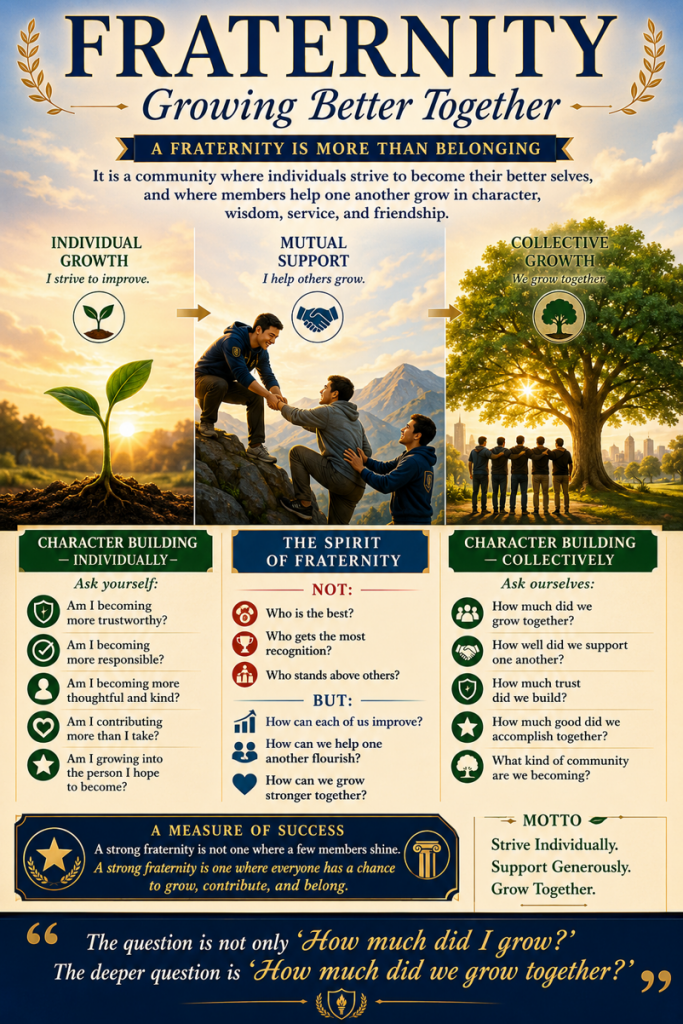
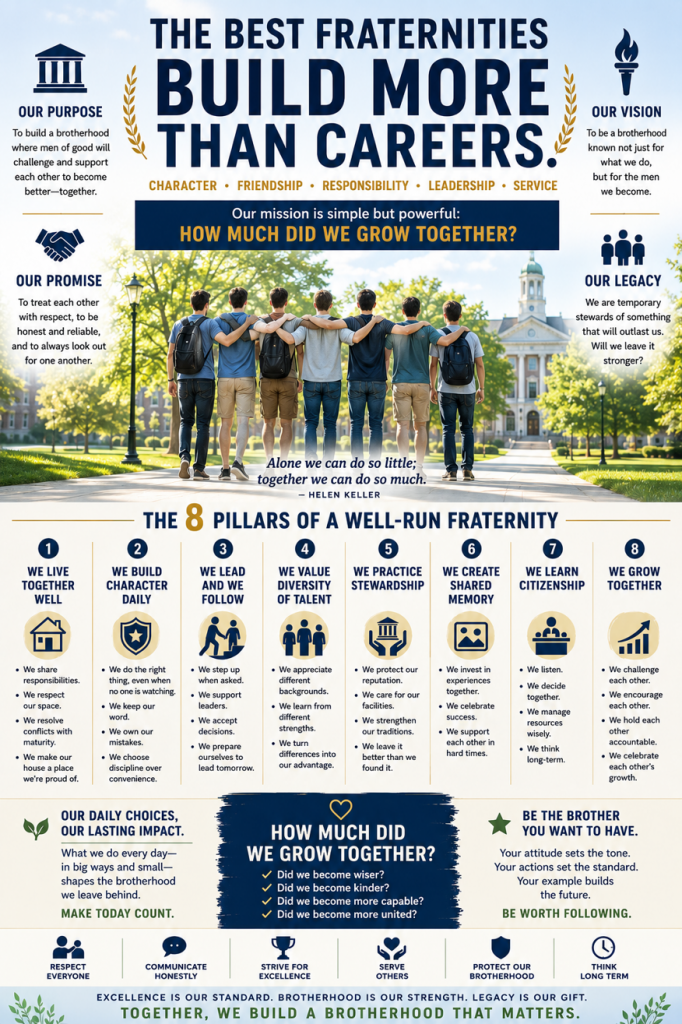
A mature fraternity asks: How much did we grow together?
- Did we become wiser?
- Did we become kinder?
- Did we become more capable?
- Did we become more united?
This shifts the focus from personal advancement to collective flourishing.
