Holistic Thinking As Succinctly As I Can by Stephen Lee – Key Words & Current Questions – July, 2024

What” is the Whole to think about?

The Wholest Whole is only limited by the ability of my imagination. The key definition is the boundary (if it exists) for including everything, and over all time. What is “everything” then … ? Holistic Thinking can be applied to a smaller Whole. But the conclusions we draw from that thinking will very likely have room for improvement when we look beyond the boundary.

An Example of Parts of one Incomplete Whole

The Universe

The Earth and All Living Things

Ethnic or Religious Groups Nations

Groups and Organizations of People

Families and Friends

Individuals

This is just one way to break the Whole into units, down to individual persons who interact over time with one another and the other parts of the Whole.

Smaller than the human size is the other direction for the boundary of the Whole to expand. Virus, nano particles, atoms, photons, Higgs particle? Invisible fields? Thoughts?

Consciousness? Free Will? Soul? “God”?

In addition to space and time as the dimensions to draw the boundary of the Whole, consider also the “dimension” consisting of the foundation assumptions of your belief system for truth and life purpose. What if some part of my belief system is different from that of another person?

Why Think in Full Consideration of the Whole?

What is your answer to this question? Our personal answer to this question is the best way to start a personal mental, emotional or spiritual journey. I leave this as an open question.

How to Think Holistically?

1. When a question (especially a serious one) comes to my mind and I want to make an evaluation or a decision about what to do next, and I have sufficient time to carefully and rationally consider the what, why, how and the possible consequences of the different paths which are open for me to choose, I would try to look at the Whole picture and consider the effects of each of my possible choices or decisions on the future paths of each of the parts of the Whole. When my choice affects another person, I need to consider what the effects are and how that person will react or choose to react. This is obviously an immense mental exercise and depending on the time available, a blend of personal rules of wisdom may need to be used. One technique is to think logically on all different parts of the question and then “sleep on it”. More ideas may pop up after our brain or our mind somehow connects the dots and then suggests some new ideas or an answer.

2. How do I know that I have found the best answer? When my mind finally can rest in peace and harmony with myself on this question. Recognizing that this is still my personal answer to my question, I accept it as a tentative solution, subject to personal lessons yet to be learned.

3. How and why we choose among the different paths ahead of us is the most difficult part of Holistic Thinking. It defines our individual wants in our own mind and in our estimation of others’ wants as well. Ultimately, if we think about what makes us happy about our whole life or what purpose, if any, we want to strive for in our life, this step of Holistic Thinking rounds out the Wholeness into a potential Unity in the Diversity of the Universe.

4. The most fatal mistake in critical or logical thinking is the False Dichotomy or the Excluded Middle (described by Carl Sagan in his Baloney Detection Kit). By casting a problem as a choice between black or white only, the argument promotes polarization. “If you are not with us, you are against us!”

5. For Holistic Thinking to be more complete, it is necessary to understand uncertainty, and learn how to make evaluation which considers uncertainty, especially when the uncertainty has a range of possibilities.

Some Key Words or Thoughts to Stimulate Holistic Thinking

● Interconnected ● Interdependence ● Working together ● See big picture ● Recognize patterns ● Parts working together for the Whole ● Cause and multiple Effects ● Multiple perspectives ● How to cut and share a Pie ● Is there a way to make everyone happy? ● What mode of interaction among the parts can make the Whole better?

Some Current Questions for Thinking Holistically

● Why is the behavior of my grandchildren so different from my own childhood behavior?

● Why has the influence of some religions declined?

● Why has Democracy in many countries become polarized or fragmented or appearing less ideal?

● Why global climate changes have not yet been taken up as an urgent world effort?

_______________________________________________________
EXCHANGES AMONG THREE OLD FRIENDS – SEARCHING FOR MEANING – NURTURING FRIENDSHIP

Billy noticed a mountain with three peaks in Yosemite National Park last week. It reminded him instantly of his friendship with two friends. He emailed this photo below to Stephen and James with a note: “ Think of you. I just discovered THREE COMICS IN YOSEMITE. See photo.”

Stephen immediately checked various sources and discovered that it is actually a well known Yosemite destination called THE THREE BROTHERS. By one source, the background story was: “ Three native American brothers were frozen into stone by the Spirits for wandering into an unforbidden area”.

James commented: Wonderful photo of the “Monument to the Three Virtues. . . COMPASSION, EMPATHY, and FRIENDSHIP.” ( The topic the Three Friends – Stephen, James, and Billy – have recently been discussing.)

Billy acclaimed: “ You Got It, James !   Indeed, this is exactly how beautiful Yosemite National Park affected most of us who have visited there. I was overwhelmed by the magic of the sprouting and unstopping waterfalls with vapor spreading mysteriously, the gigantic and unshakable granite walls which seems to grow stronger and sturdier the longer I stare at them, the tall pines shooting perfectly straight towards the sky seems to gather in number as I try to count them, the placid water surfaces sometimes blue in color, sometimes green, sometimes black, can turn white as it becomes a roaring river pulled by gravity – hitting and diverting different obstructions along its way. It’s so magical.

But the important effect is not just Awe or a sense of Peace due to its Natural Beauty, however. The visitors interaction and goodwill spirit seems to grow in such surroundings.

Since 1890. Yosemite National Park has attracted millions of people from around the world to connect there and feel the common innate Goodness in Each and All of Us. This seems to promote Compassion.

Many of us, strangers, reach out to each other and have delightful conversations to discuss Beauty of Nature and learn more about each other’s personal experiences and different cultural backgrounds. Separate travelers often give each other a hand as needed – generously and caringly. We shared stories about struggles and accomplishments which can be both helpful and entertaining. This seems to promote Empathy.  

The planned trip and shared unique experience – physically demanding or moderate – definitely deepened the bonding among all of us. It’s Friendship and Feeling of Connectedness in the pursuit of Beauty, Joy, Meaning in Life together.

___________________________________________________
Let’s try to have the National Park Service change the name to “ Monument of The Three Virtues: Compassion, Empathy, and Friendship.”

____________________________________________________
Friendship and Compassion

STEPHEN LEE CONTINUES TO EXPLORE DIFFERENT CHARTS –

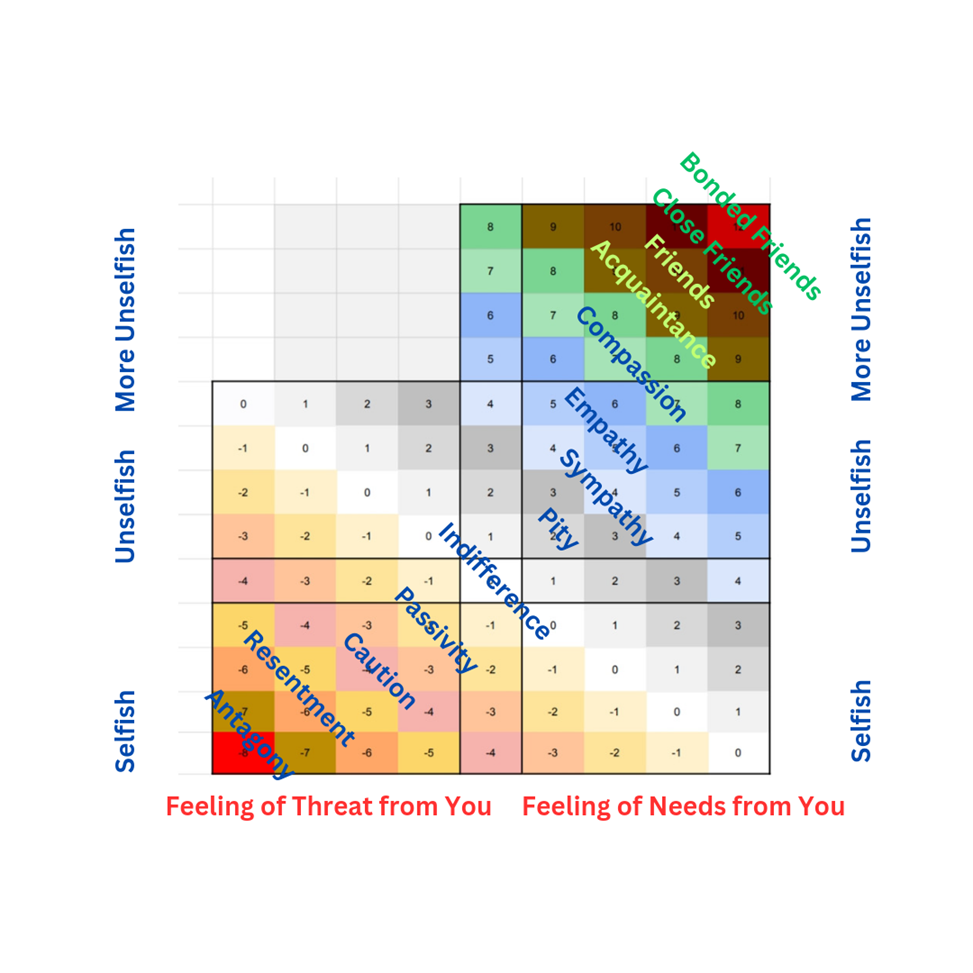
From: “Mindfulness Turns A Brain from Antagony to Compassion” to “Self-assessment For Personal Growth in Good Citizenship”, to adding “Four Levels of Friendship” to the above.   May 2023

It occurred to me after creating the two-dimensional and four-quadrant chart in my last posting on How to Turn Fear to Compassion, that there is an interpretation for the number inside each small box of the chart.

An obvious interpretation is a score of Fear vs Compassion, ranging from -8 to +8.

Let’s explore the following definition:

Good Citizenship = Unselfishness + Understanding of the Needs of Others

Poor Citizenship = Selfishness + Suspicion of the Intention of Others

Then we can interpret the numbers in each small block of the chart as a Score of Good or Poor Citizenship. In this perspective, the words in the lower left quadrant should be revised to describe poor citizenship. The new chart is as follows.

A score of zero may be described as an Indifferent citizen. A score of 1 – 2 may be described as a citizen with Pity for others. A score of 3 – 4 as one with Sympathy, 5 – 6 as one with Empathy, and 7 – 8 as one with Compassion.

On the score of Poor Citizenship, the adjectives to describe the different levels may be Passive, Cautious, Resentful, and Antagonistic?

Citizenship Score (-8 to +8)

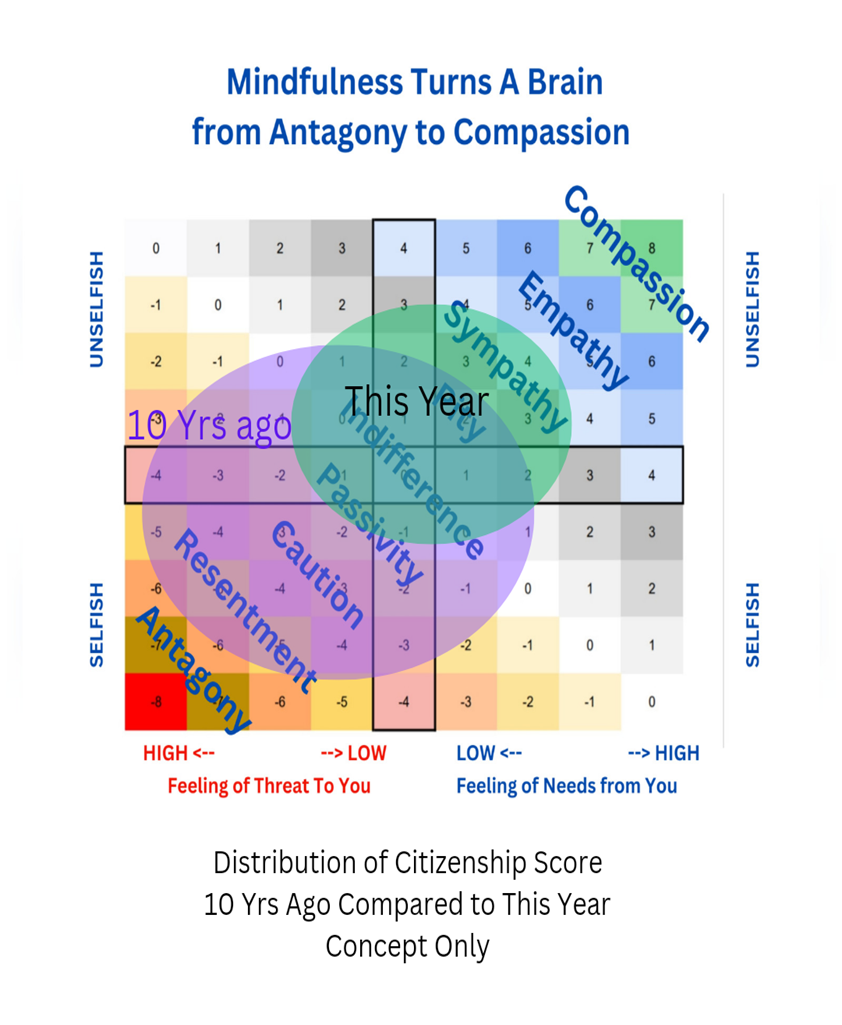
If a social score (from -8 to +8) is self-awarded to a person after a mindful act self-assessed with a Citizenship Score, it would be informative to self-ask how he or she would rate his or her level of Selfishness to Unselfishness, from -4 to +4. This is of course a subjective and qualitative self evaluation, but over time, the self assessment will still provide a valuable indicator of self improvement.

Then the two numbers, the social score and the self rating of Unselfishness, would be two useful statistics. They can be also visualized as statistical distributions or a statistical mean value of the person doing the self assessment or for a group of people if the data are collected for people in different groups, socially or culturally. If both the social score and the self-assessed Unselfish index for a population are plotted as a statistical distribution on top of the chart, as shown in the following chart, for two different years, the improvement would be noticeable.

This approach would also be used for comparing different groups of people over the same year of study, for example, to see if culture makes a difference.

_____________________________________________________________________
A NEW CHART EXTENDING COMPASSION INTO FOUR LEVELS OF FRIENDSHIP.

Acquaintance

Friends

Close Friends, and

Bonded Friends   ( This last one is akin to the Chinese male bonding of Yi Qi )

CONTINUING THEIR COLLECTIVE FUN & CREATIVE EXPLORATIONS – STEPHEN LEE CAME UP WITH SOME AMAZING GRAPHICS

April 2023 Stephen Lee sent to Billy and James:

Billy to Stephen, and James:

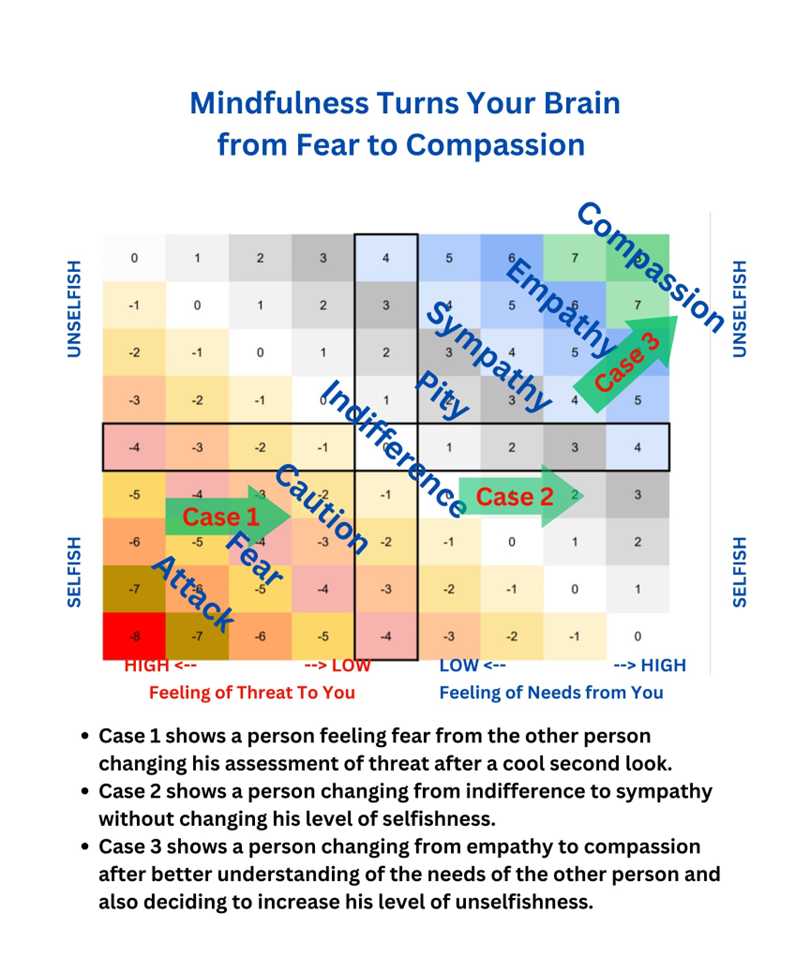
Just realized that the ARROWS Stephen introduced in the charts are truly essential to our research Why they move in a certain direction to start with ?  What triggers ? What encourages ? Why slow down, stop, or turn around.?  Even turn around again ?  How can that be facilitated etc. etc. etc. ?

Stephen to Billy and James:

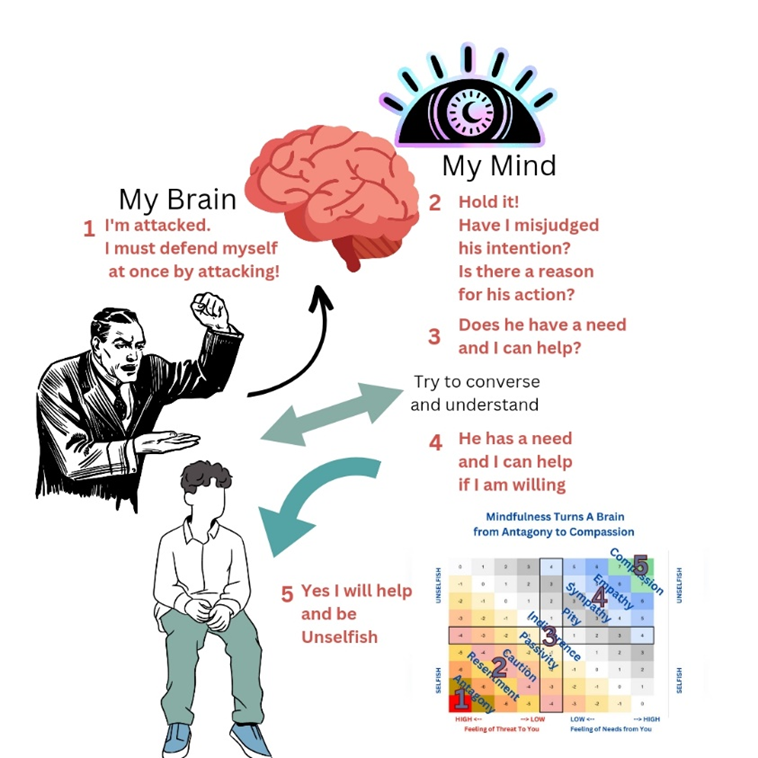
The attached picture is my answer to Bill today about the different steps to change my own behavior from antagonistic to compassionate. I suppose there are other ways to get there

James Luce to Stephen and Billy:

Not sure that Antagonistic is the correct word in this context.

Billy to Stephen:

Your Graphic is Fabulous. You are basically a Good Person with A Good Conscience, Stephen. Some people lack a Good Conscience. Yes,how can we build Good Conscience ?

May I suggest that you illuminate more about the ARROWs you showed in your earlier chart ?  Each directive arrow may represent first One’s Conscience, then Mindfulness, Reflection, and Commitment – all your words ?

Come up again with some amazing Stephen Lee graphics !

________________________________________________________
Deepening Friendship and Bonding, Pursuing FUN & CREATIVE Ideas Together. Compassion vs Fear

Three Friends: Bill or Billy ( an Architect ), James ( a lawyer ), and Stephen ( an Electrical Engineer ), were having fun lately – playing psychologists and seeking Truth and Meaning about COMPASSION.

Below is a report by Stephen which illustrates their recent collective FUN & CREATIVE Pursuit.

Mindfulness Turns Fear to Compassion

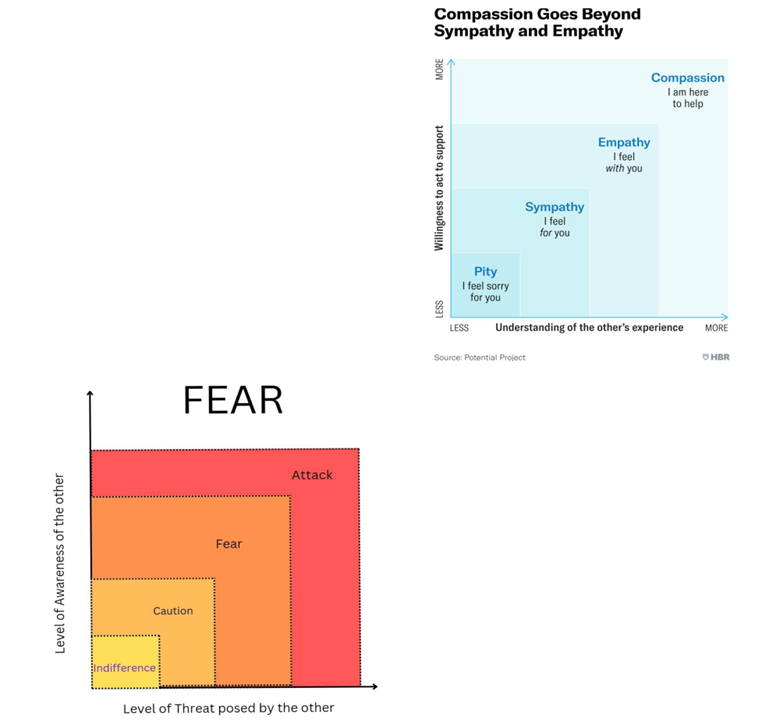
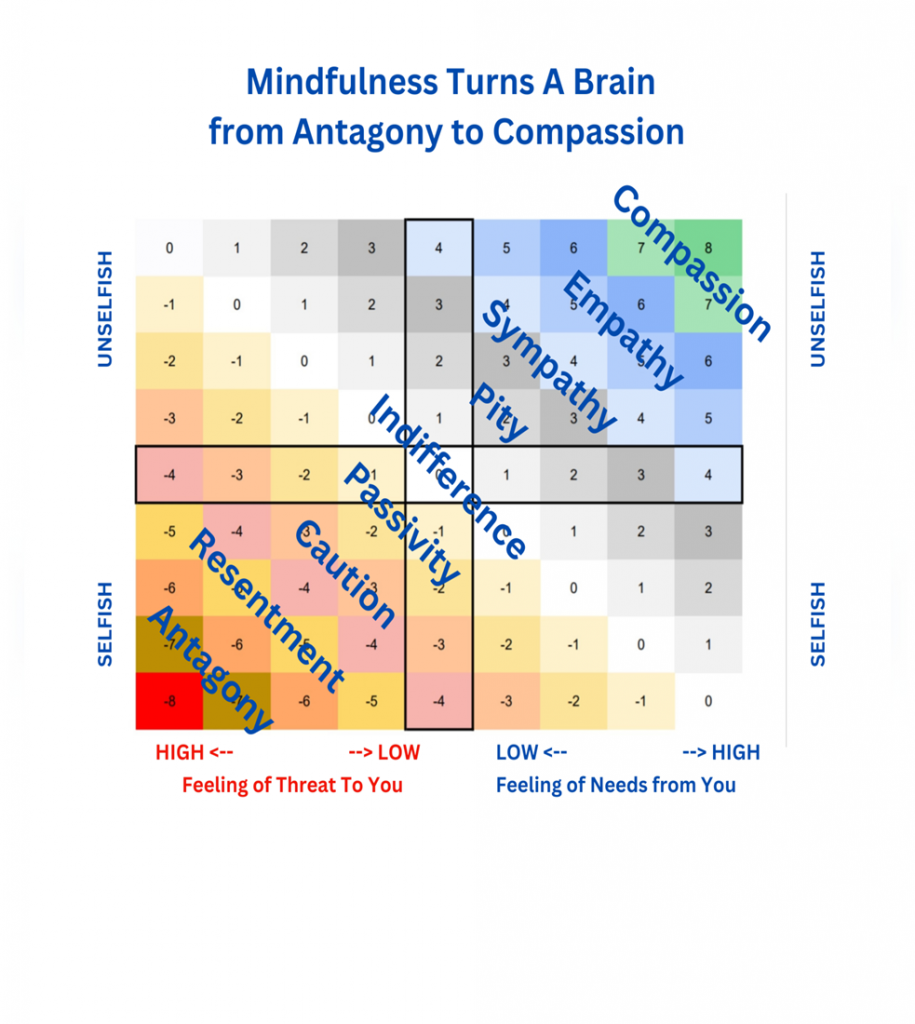
The following four Charts were built on ideas and works of three friends. More immediately, some of the ideas came from my friends Bill Lee and James Luce, and I simply internalized them with my personal philosophy to combine the two charts into one. This figure shows the two original charts. The upper right one came from Bill’s readings on Compassion. The lower left chart was created by James at the request of Bill.

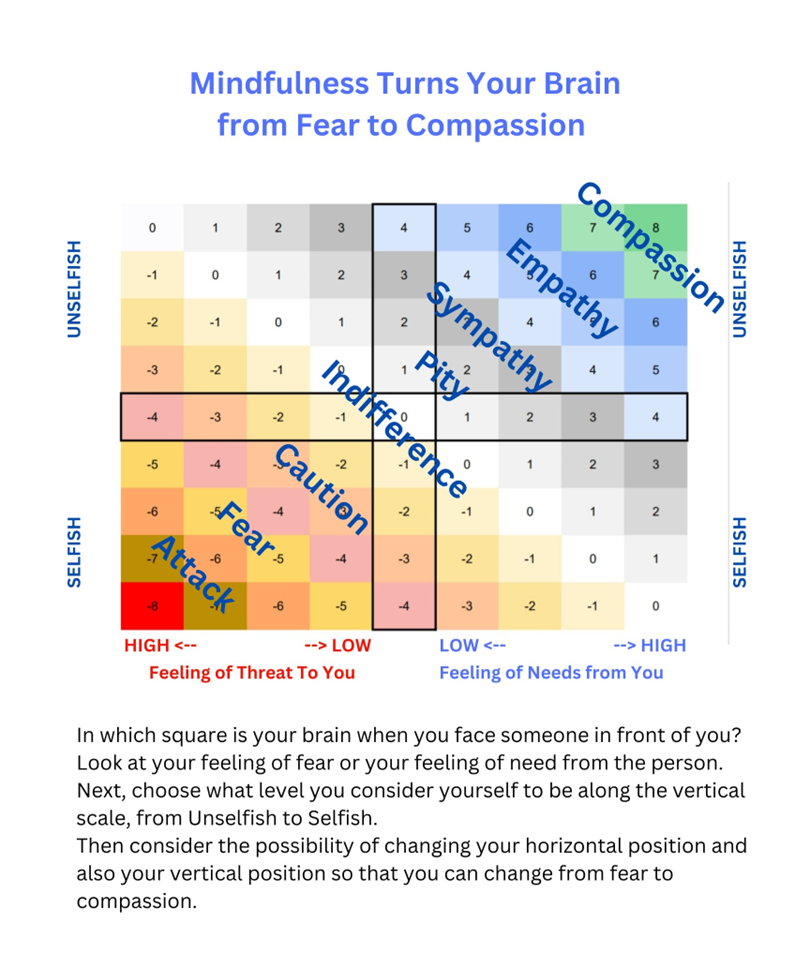
I recognized that both charts have two axes and that if the value of the horizontal axis of one chart is rephrased to be the opposite of the value of the other horizontal axis, then both charts become connected. The same reasoning suggests that the two vertical axes can also be rephrased so that the two charts can be interpreted as a single chart. This thought results in the following chart. The horizontal axis ranges from High Feeling of Threat to You, to Low Feeling of Threat to You, and then crosses over the vertical axis to Low Feeling of Needs from You, and then to High Feeling of Needs from You.

The vertical axis ranges from High degree of Selfishness from the bottom of the chart to High degree of Unselfishness at the top of the chart. Then a color scale is painted on each little square of the chart to start from Red to represent an extreme feeling of threat and selfishness which causes the primitive reptilian brain in humans to attack out of fear and survival instinct. The color changes towards the Green color representing compassion at the upper right corner of the chart.

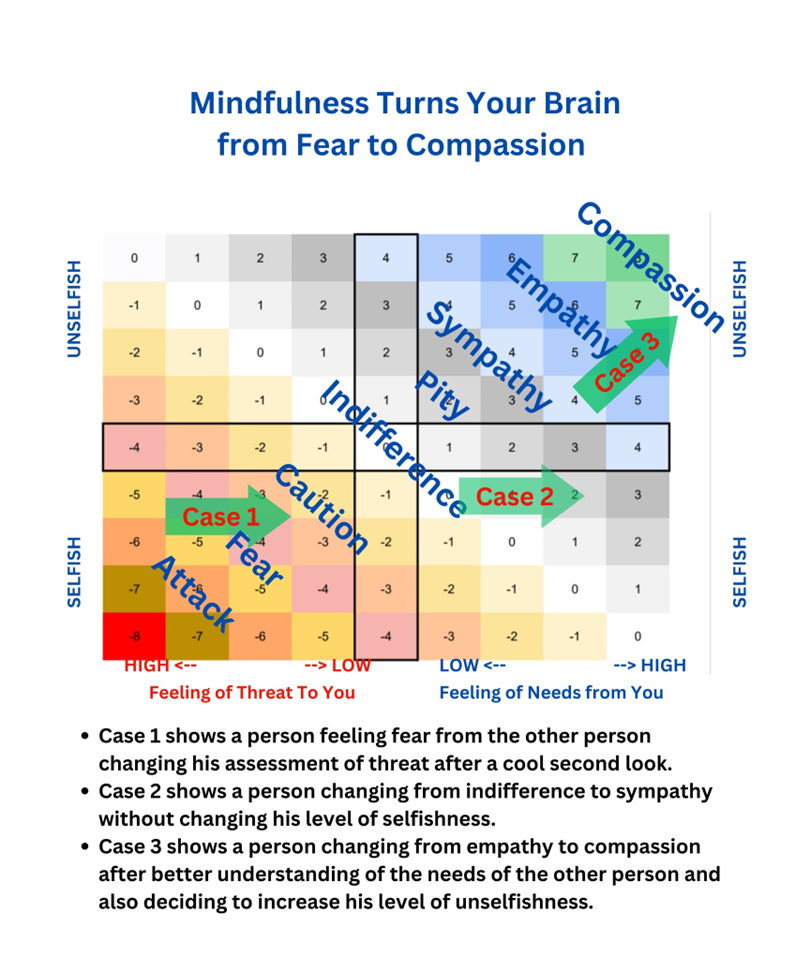
Then the second chart was created by adding three application cases to illustrate how Mindfulness can help a person to modify the reflex instinct of fear and survival towards the humanistic behavior is controllable by the more evolved human brain which can make reasoned decisions according to our personal values which take into account our tradeoffs between the self and others, as well as our often-flawed instinctive awareness of the intention of the other person.

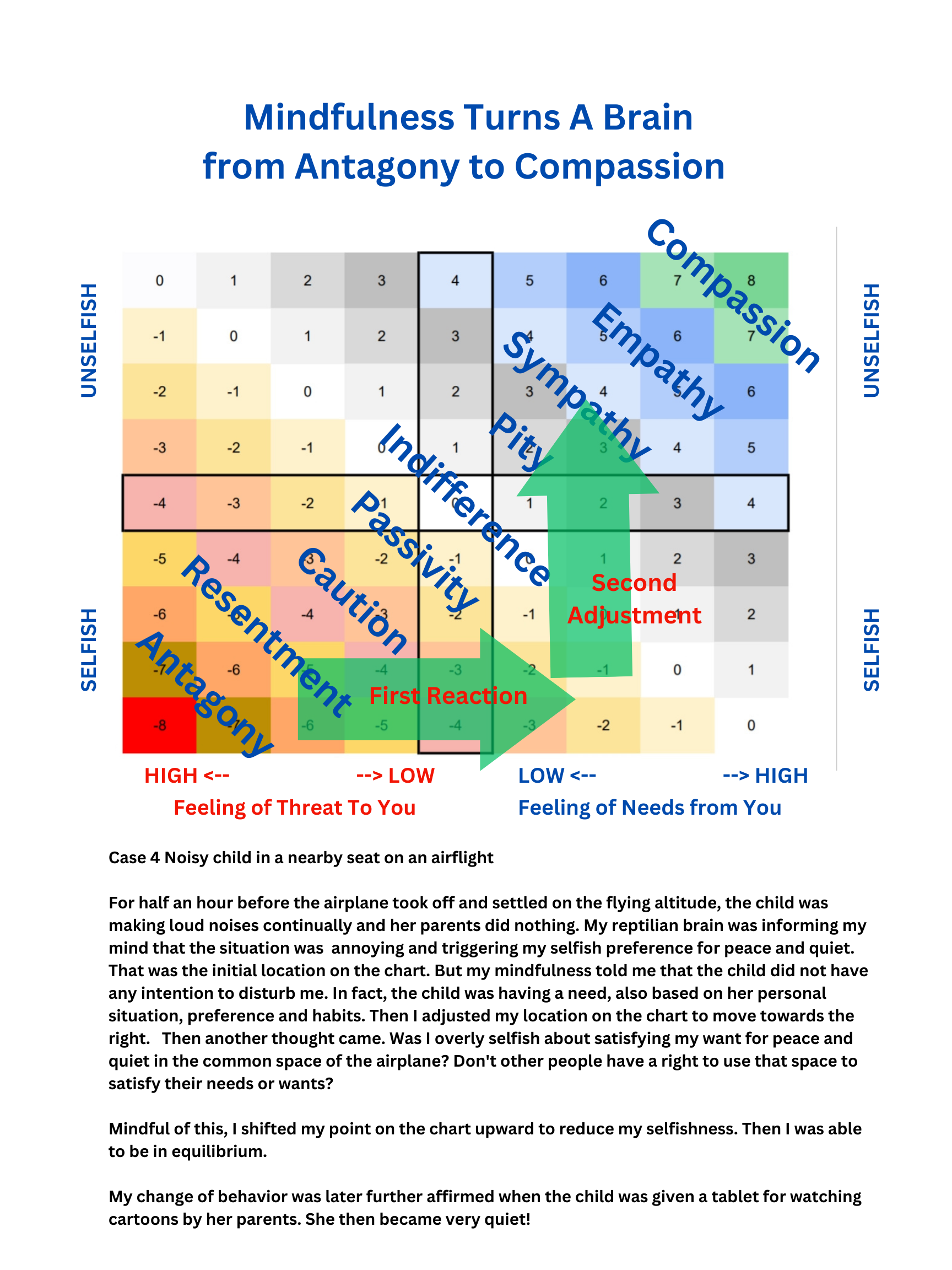
The final chart adds a fourth case to the examples. It was an actual experience yesterday while traveling in an airplane.

April 12, 2023

Stephen Lee

Reflection

Compassion, Fear, Mindfulness

___________________________________________________________________