Just realized that the ARROWS Stephen introduced in the charts are truly essential to our research Why they move in a certain direction to start with ? What triggers ? What encourages ? Why slow down, stop, or turn around.? Even turn around again ? How can that be facilitated etc. etc. etc. ?
Stephen to Billy and James:
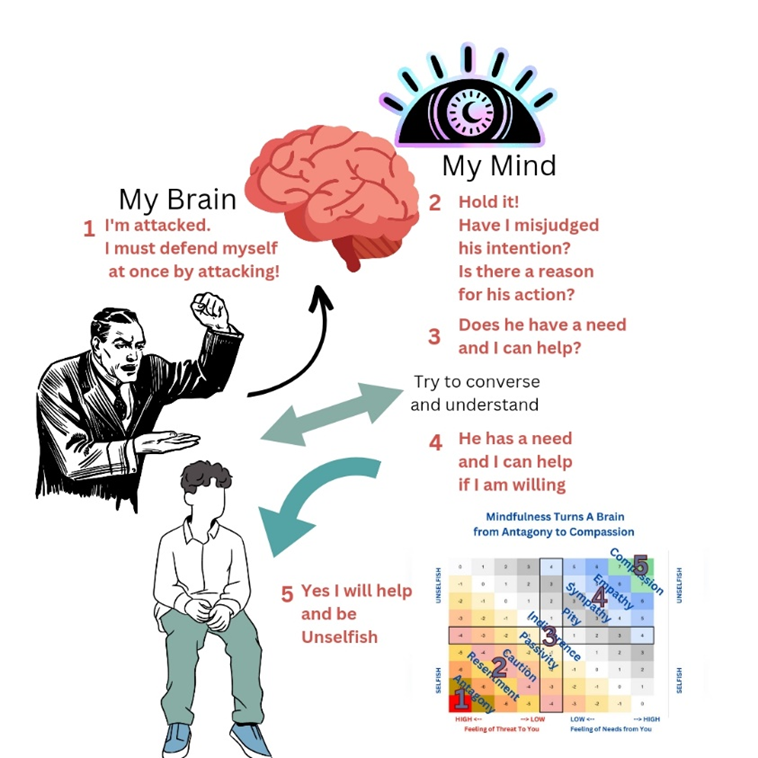
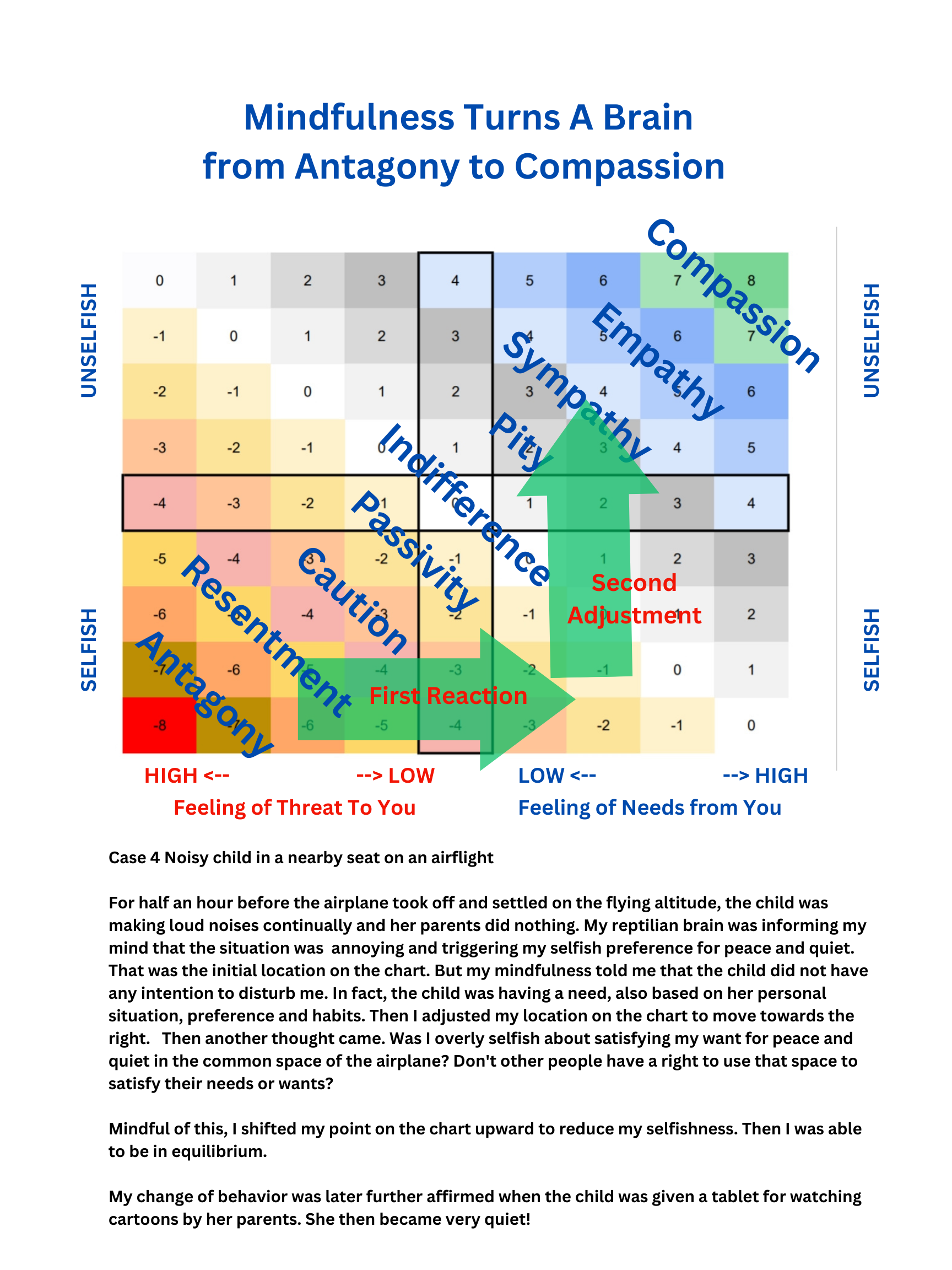
The attached picture is my answer to Bill today about the different steps to change my own behavior from antagonistic to compassionate. I suppose there are other ways to get there
James Luceto Stephen and Billy:
Not sure that Antagonistic is the correct word in this context.
Billy to Stephen:
Your Graphic is Fabulous. You are basically a Good Person with A Good Conscience, Stephen. Some people lack a Good Conscience. Yes,how can we build Good Conscience ?
May I suggest that you illuminate more about the ARROWs you showed in your earlier chart ? Each directive arrow may represent first One’s Conscience, then Mindfulness, Reflection, and Commitment – all your words ?
Come up again with some amazing Stephen Lee graphics !
Three Friends: Bill or Billy ( an Architect ), James ( a lawyer ), and Stephen ( an Electrical Engineer ), were having fun lately – playing psychologists and seeking Truth and Meaning about COMPASSION.
Below is a report by Stephen which illustrates their recent collective FUN & CREATIVE Pursuit.
Mindfulness Turns Fear to Compassion
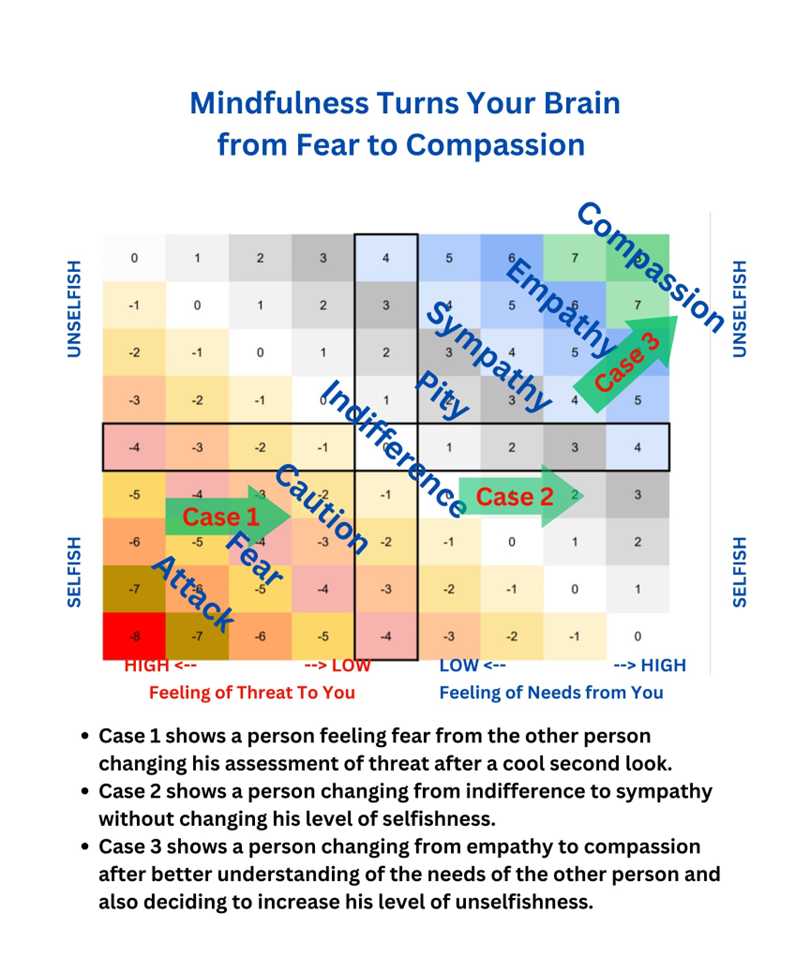
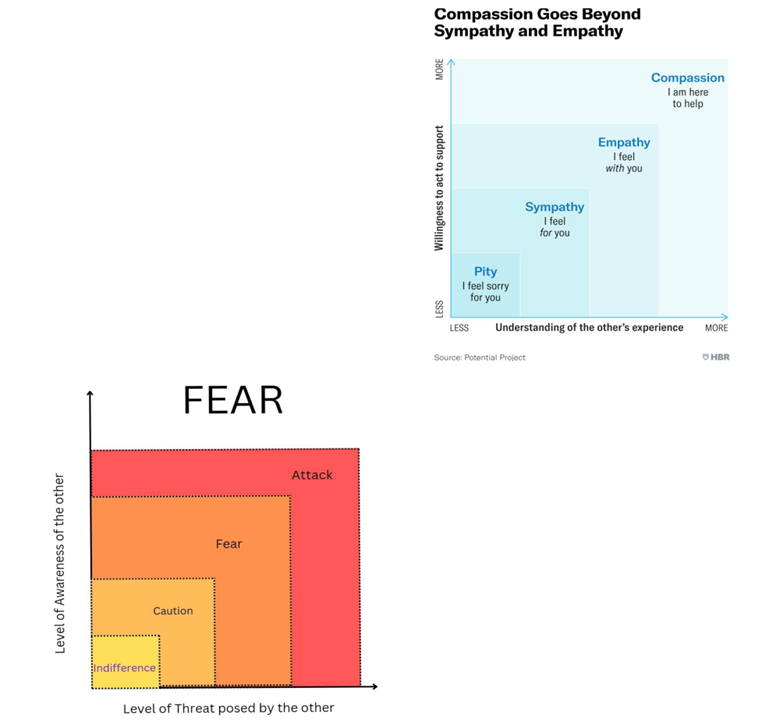
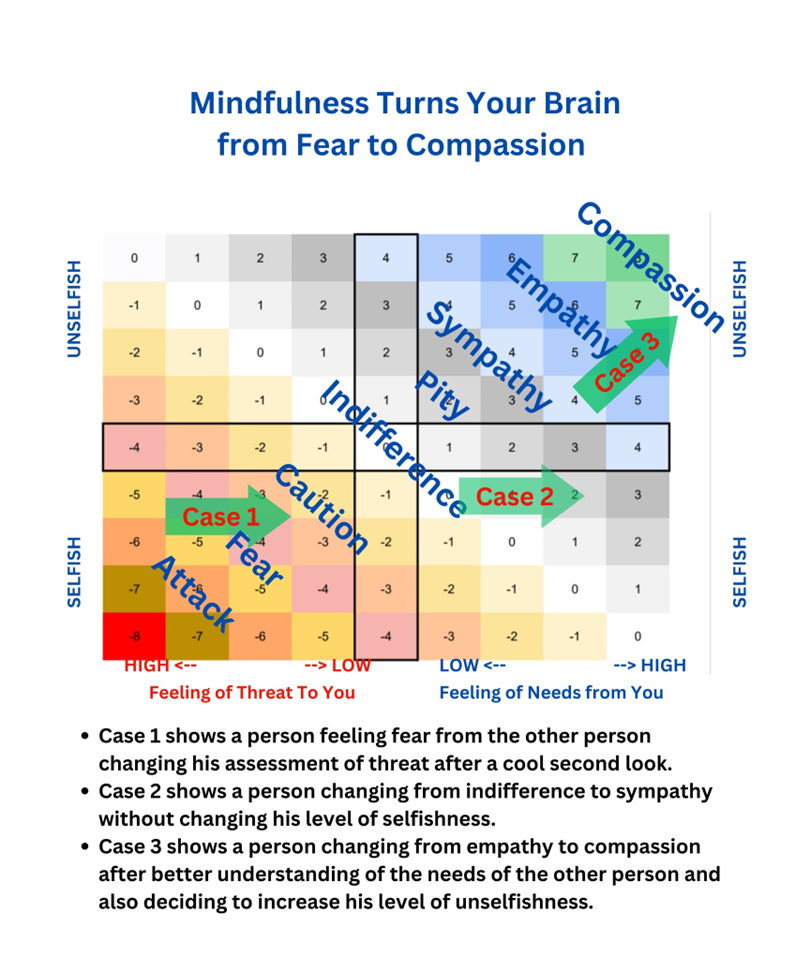
The following four Charts were built on ideas and works of three friends. More immediately, some of the ideas came from my friends Bill Lee and James Luce, and I simply internalized them with my personal philosophy to combine the two charts into one. This figure shows the two original charts. The upper right one came from Bill’s readings on Compassion. The lower left chart was created by James at the request of Bill.
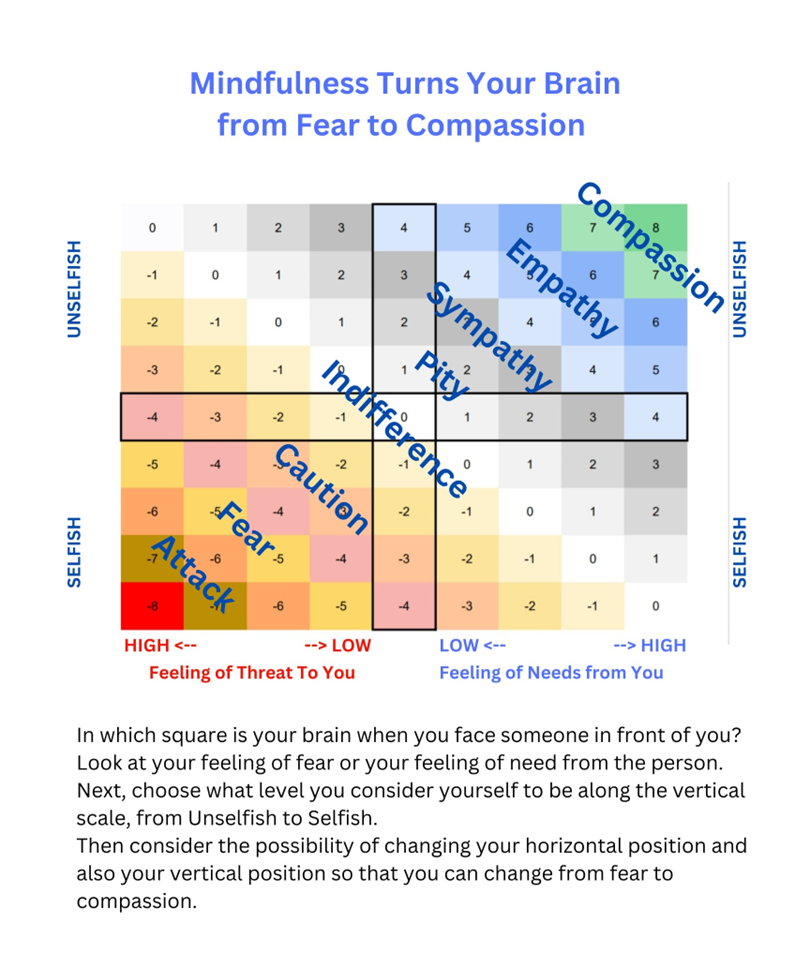
I recognized that both charts have two axes and that if the value of the horizontal axis of one chart is rephrased to be the opposite of the value of the other horizontal axis, then both charts become connected. The same reasoning suggests that the two vertical axes can also be rephrased so that the two charts can be interpreted as a single chart. This thought results in the following chart. The horizontal axis ranges from High Feeling of Threat to You, to Low Feeling of Threat to You, and then crosses over the vertical axis to Low Feeling of Needs from You, and then to High Feeling of Needs from You.
The vertical axis ranges from High degree of Selfishness from the bottom of the chart to High degree of Unselfishness at the top of the chart. Then a color scale is painted on each little square of the chart to start from Red to represent an extreme feeling of threat and selfishness which causes the primitive reptilian brain in humans to attack out of fear and survival instinct. The color changes towards the Green color representing compassion at the upper right corner of the chart.
Then the second chart was created by adding three application cases to illustrate how Mindfulness can help a person to modify the reflex instinct of fear and survival towards the humanistic behavior is controllable by the more evolved human brain which can make reasoned decisions according to our personal values which take into account our tradeoffs between the self and others, as well as our often-flawed instinctive awareness of the intention of the other person.
The final chart adds a fourth case to the examples. It was an actual experience yesterday while traveling in an airplane.
Will Schwalbe and Chris Maxey, in my opinion, are destined to become friends. They are both likable human beings who very much wanted to be liked. They basically believed in the value of Friendship from the start and was willing to risk the full Senior Year at Yale– two nights every week- to mix with fourteen especially diverse classmates most of whom they did not know well. BZ, Berzelius Senior or Secret Society at Yale indeed brought them together, and the BZ’s Audit tradition indeed encouraged them to explore personal differences and find beauty in the other persons.
The story focused on Will (a Nerd) and Maxey (a Jock) joining BZ. Will is also Gay while Maxey became a Navy Seal. Normally that is not going to mix well. It took time to learn about one another. It took many special moments and the right atmosphere to spark connectedness and eventually intimacy. The book described their growing friendship from Bright College Year, to Twenties and Thirties, to Midlife, Forties, Fifties, Middle Fifties, Pushing Sixty, and Coda. I salute the two fellers for being honest and sincere – more importantly civil and respectful- and indeed their conscientious efforts to keep good vibes continuing. Each feller is intrinsically Loving and Lovable and each possessed amazing abilities and character. Their separate life stories are genuinely impressive notwithstanding.
I truly believe that The BZ Audit Tradition indeed challenged their quest to form Friendship with different contrasting personalities. Indeed, BZ had a reputation for emphasizing Diversity. It was the first among the Secret Societies at Yale to admit Black members. It was the first to welcome Female members. I believe I was recruited partially because I came to the U.S. from Shanghai, China. The Audit Program was carefully guided, and it has been proven to be very successful. BZ’s Mission: Achieving Insight thru Open, Honest, Exchanges of Experiences – a Place for Contemplation & Reflection- Develop Good Characters, Tolerant of Others- Forging links, Mind to Mind, in a Chain Unbroken.
Place of Engagement is significant to me, an Architect. For Will and Maxey, their magic place is the Roof of the Hall. The need to climb up thru a hatch and to find open sky must have affected their mind and opened their hearts.
I also believe in Angels. For me there is clearly a Third Person in this amazing story. On top of Page 170 David Singer yelled at Will: “He’s hurting. A lot. Just fucking call him.” Will called Maxey who was in distress. Very often a Friendship is guided or saved by a caring Third Friend. ___________________________________________________________________________+
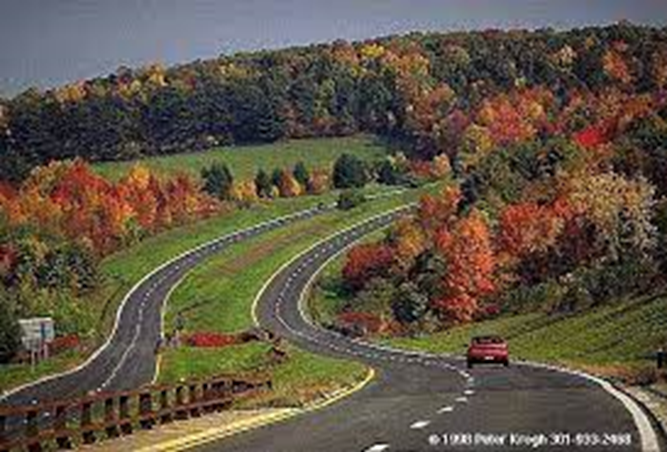
The post in your blog about friendly architecture had me a little puzzled at first, as this is a new way of thinking for me about architecture. I had observed that architecture of makes a statement, for example through form and function, but friendliness hints at the subtle effects that architecture has on the soul and the senses. Shortly after reading the article, I found myself exploring the map of the US, curious about places and regions where I used to live or had traveled. A memory arose in my consciousness about a road that I used to drive on my way between Baltimore and the Albany, NY area shortly after graduating from college in the early 1970’s.. The road is The Taconic State Parkway.
Here’s an excerpt from Wikipedia under the heading of Scenery:
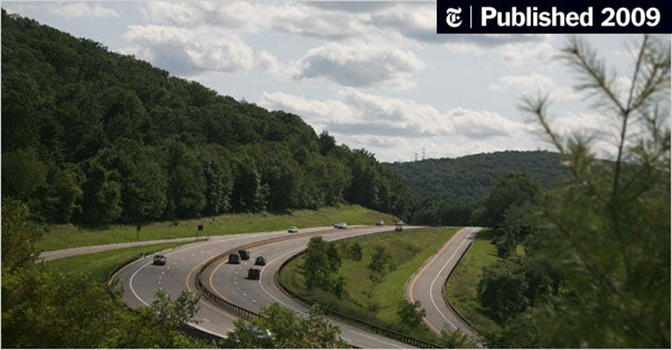
Landscape architects such as Gilmore Clarke worked closely with engineers and construction crews during the Taconic’s construction, often on site. Some features of the road’s design address practical considerations and increase safety. Curves that climbed or descended were banked to increase vehicle traction and permit better drainage. Likewise the curves in undulating terrain are located to reduce blind spots at crests and keep the sharpest turns out of valleys. These also make sure that views of distant landscapes open up on downgrades and on long curves, when they are less distracting.[12]
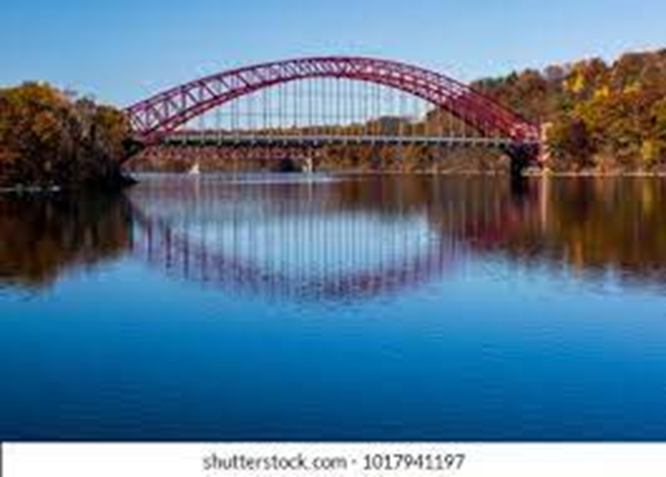
Closer to the road, on the northern sections in Columbia and Dutchess counties, the road was routed to showcase a nearby view of wooded hillside or a farm. Since trucks were not permitted on the road—for some time, this even included privately owned pickup trucks used solely for personal use—in many sections tree branches overhang the roadways, creating a park-like canopy. The curve of the northbound AMVETS Memorial Bridge over Croton Reservoir echoes the surrounding hills. On the medians and berms, plantings were carefully planned to maintain continuity with the surrounding woods. On the descent into Peekskill Hollow in Putnam Valley, the trees and shrubs above the retaining wall on the east side were transplanted from the path of the highway, which retained the appearance of the local forest and saved money.[13] Overpasses, both carrying roads over the parkway and carrying it over roads, were faced in native stone.[12] Grade intersections, usually a feature engineers tried to avoid, which initially helped keep local east–west routes open[14] and connect the parkway to the landscape it traversed,[15] have since either been closed or replaced by overpasses.
As a result, the Taconic has been the subject of much praise over the years not only for its vistas but for the way it harmonizes with the surrounding landscape. Sociologist Lewis Mumford, who often criticized the effect of superhighway construction on contemporary cities, always advised friends traveling up from New York to visit him at his house in Amenia that they should take the Taconic.[16] He described it as “a consummate work of art, fit to stand on a par with our loftiest creations”.[17] The engineers, he said, had avoided “brutal assaults against the landscape.” Albany-born novelist William Kennedy, whose family frequently drove the Taconic during his childhood to visit relatives further south, called it “a 110-mile [180 km] postcard. It’s the most beautiful road I’ve ever known—in all seasons.” “You can drive it with confidence”, said automotive writer David E. Davis. “There are no bad surprises about the way the road is engineered.”[18] Landscape architect Garret Eckbo called the Taconic “as lovely an integration of highway engineering and landscape architecture as one could hope to find”.
Commenting on this years later, architecture critic Matthew Gandy wrote:
Clarke’s design for the Taconic State Parkway, for example, provides a vivid example of a new kind of mediation among nature, technology and society, with what appears to be a delicate balance between the new infrastructural project and an imaginary natural order. Implicit within this aesthetic dialectic is the notion of engineering as an art form that can in some way embellish or even improve upon nature: there is no radical disjuncture here but a sense of aesthetic progression and purity of form.[19]
So there you have it, one example of “friendly” architecture.
Billy found the following Taconic State Parkway photos from Googling. He learned from Ed Wuenschel’s writing above that indeed FRIENDLINESS is a JOYFUL FEELING created thru THOUGHTFULNESS and UNDERSTANDINGof HUMAN NATURE and our INTIMATE RELATIONSHIP to NATURE :
FRIENDLINESS, indeed, privides a warm feeling of COMPANIONSHIP WITH THE SURROUNDING and the satisfaction of FEELING THE WONDERFUL BRIDGING and CONNECTING.
Explicitly, this practice means coming from love in a broad sense – from compassion, good intentions, self-control, warmth, finding what to like, caring, connecting, and kindness.
Implicitly and more fundamentally, this practice means a relaxed opening into the love – in a very very broad sense – that is the actual nature of everything.