A PERFECT BOYFRIEND ?

After reading  “A Perfect Girlfriend “ by Flavian Mwasi, Billy wondered “What makes A Perfect Boyfriend ?

He learned from an article by Bella Smith ( a Human Behavior/ Psychology Enthusiast ) that  A Perfect Boyfriend must understand the following SECRETS.

Women are attracted to a man not totally by his accomplishments but by how he makes them FEEL. AS A PERSON.

Not all the time, we like to be dependent on you. Sometimes we like to support you financially as well as mentally.

We feel special when you remember small details about us.

We love it when you open up to us when you tell us about your fears, your worst problems, and your inner demon. It makes us feel that we are really important to you.

We are possessive by nature. We can get jealous when we see you talking with other girls.

We know how we look, still, we ask you because we love it when you appreciate our beauty.

We find intelligence without arrogance sexy. It’s extremely sexy when a man knows how to maintain his intelligence without riding a high horse in the process.

We want a man who is in control but not controlling. There’s a difference.

We don’t give up easily on a man who we love, but once we’re done, no matter what you do, we never come back.

We love it if you tell your parents and friends about us. It means a lot.

We know how we look, still, we ask you because we love it when you appreciate our beauty.

We love it when you caught us staring at you and ask “what..?”

We want to be with a Nice Guy who is confident and a leader; who holds boundaries, respects himself, and with massive sex appeal.

No woman wants to be with a weak man, but we love dominance at times.

Three magic words every woman wants to hear other than “I love you”:   ” I appreciate you”.

_____________________________________________________________

INPUT FROM DORIS LAM:

A few Internet searches that resonate with me are shared below.

Men want love as badly as women do. They just might not always be as obvious about it. But generally, they want the same thing: friendshipcompanionshipchemistry.

Traits that women tend to value and need most from their romantic partners are integritysensitivity, and intimacy. Women need the men in their lives to be feminist allies who want to see them succeed.

男朋友 

由於自由戀愛的發展,男朋友在人們心中的概念也從單一的男生朋友發展到了做“丈夫”之前的對象的代名詞。現在大部分人對“男朋友”的理解都是“他是和你有戀愛關係的男生”可是把你的男生朋友說成是你的男朋友也不為過,因為現在人都開放了,男女之間也有友誼這種關係了。

交友解讀編輯

1、朋友具有彼此的獨立性。朋友之間最重要的是相互尊重,求同存異,雙方都有人格的獨立性,如果雙方密切到使對方感到受束縛,友情將難以維繫。

2、朋友不具有專一性。你的朋友有權同時選擇別的朋友,並且不一定以你的喜好作為選擇的標準。

The Chinese quotes pointed out that due to the gradual change from a male dominated culture, a female will desire more IDENTITY, and INDEPENDENCE.

I also found the following article a good attempt to explain UNCONDITIONAL RELATIONSHIP.

### 

Doris

_____________________________________________

Melissa Luce indicated that the article Billy seeks has already been written by

Rachel Hosie– back in 2018 in the Independent and republished recently

in Yahoo News. https://news.yahoo.com/man-9-qualities-never-let-081808214.html

A Perfect Boyfriend should satisfy the following criteria:


1. He’s smart

While some of us are naturally brainier than others, a new study from the Hanken School of Economics in Finland suggests that the smarter the man, the less likely he is to be unfaithful. According to the research, more intelligent men are more likely to get married and stay married.

So if you’re worried your boyfriend might be too brainy for you, a) don’t be intimidated because intelligence isn’t everything, and b) know that you may have a guy who’s more likely to be faithful on your hands.

2. He makes you laugh

Finding someone you can have a laugh with is crucial – even if everyone else rolls their eyes at his dad jokes, if they crack you up, that’s all that matters.

And a study has shown that men are more likely to have “mating success” if they have a GSOH.

3. He actively supports your career

A study found that husbands were a deciding factor in two-thirds of women’s decisions to quit their jobs, often because they thought it was their duty to bring up their children.

Even when the women in the study described their husbands as supportive, they also revealed that the men refused to change their own work schedules or offer to help more with looking after children.

4. He makes as much effort with your friends and family as you do with his

It’s not uncommon for a woman to end up giving up her own social life to slot into her new man’s. But it’s rare that a man does the same once entering a relationship.

In fact, a recent study found that young men get more satisfaction out of their bromances than their romantic relationships with women. While this is clearly ludicrous, maintaining your friendships is important. So make sure you’re with a man who not only wants you to make time to see your friends but also makes an effort to get to know them too.

5. He’s emotionally intelligent

If stereotypes are to be believed, it is women who are always desperate to talk about feelings and never men who fall hard. Whilst this definitely isn’t true, it’s important each person in a relationship has a certain level of emotional intelligence.

Studies suggest that women are better at taking the opinions and views of their partner into consideration than men, which is essential for a healthy relationship.

6. He respects your opinions and listens to what you have to say

Being closed-minded isn’t a trait that’s exclusive to a particular gender, but if a man is convinced he’s always right and will never consider your argument, it’s not a good sign.

If a man rejects his female partner’s influence, it may be a sign that he has power issues, according to Dr John Gottman, author of The Seven Principles for Making Marriage Work.

7. He’s willing to put the work in

study from the University of Texas found that the most successful relationships weren’t down to compatibility, but rather making the relationship work. “My research shows that there is no difference in the objective compatibility between those couples who are unhappy and those who are happy,” study author Dr. Ted Hudson said.

So if you or your partner is always looking for the next best thing rather than committing to make your relationship last, it may not bode well.

8. He celebrates your achievements

Whether it’s deadlifting your bodyweight or learning enough German for a trip to Oktoberfest, it’s important to have a partner who celebrates your achievements.

But this isn’t just to make you feel great – a study published in The Journal of Personality and Social Psychology found that couples who did so were more satisfied with their relationships than those who reacted negatively or were indifferent.

9. He shares your values

Having a similar outlook in life could be crucial to a successful relationship, according to a study. The more alike your personalities are, the more likely you are to approach problems in the same way.

You and your partner will share similar approaches to everything from socializing to working if your priorities are the same, and this is likely to lead to a greater level of respect for one another.

____________________________________________
A few Thoughts About Friendship and the Workings of the Mind – by Andrew Rossi- September 2022

The author is a neuroscientist, a mediocre tennis player, and a longtime friend of the Lee family.  He lives with his wife and son in Potomac, Maryland, where he can often be found chatting up complete strangers to the amusement and/or embarrassment of his family.  The ideas expressed within are his alone and do not reflect the views of the National Institutes of Health or the United States Government.

Several years ago, my good friend Gary Lee told me that his father was working on a “friendship project”.  I was intrigued.  The more I learned about it, the more I thought this was a brilliant and important thing to do.  The resultant Friendshipology website contains a variety of enlightening and beautiful essays, many of which describe personal experiences of friendship.  This site serves as a wonderful reminder of the value and power of friendship (thank you Billy Lee!).  Earlier this year, Billy asked me to contribute an essay to Friendshipology with the seemingly simple suggestion that we might be able to learn something about the nature of friendship from recent advancements in neuroscience.  Now, how hard can that be?  Just apply what little we know about the seemingly infinite complexities of the brain to understand the infinite complexities of friendship.  I have to wonder whether Billy has profoundly overestimated my ability to connect these two topics, or perhaps he is just punishing me for something I did when I was a teenager.  Unfortunately, despite all the recent progress in neuroscience, we remain far from a good understanding of the neurobiology of friendship.  Nevertheless, Billy’s suggestion has preoccupied me for the last couple of months.  What follows are some linking propositions that relate our current thinking about the operations of the mind to some observable features of friendship.  I have avoided speculation about the biology of friendship, and at times I have strayed from the science-of-the-mind theme altogether, but I hope the friendly readers of Friendshipology will find these meanderings as interesting and provocative as I do. 

As a scientist, my inclination is to start with first principles.  I began with the question: What is friendship?  I don’t have an easy or definitive answer to this question.  The Webster’s Dictionary defines a friend as 1) a person who has a strong liking for and trust in another person or, 2) a person who is not an enemy friend or foe.  I think we can all agree that this definition, though not inaccurate, does not remotely capture the nature of friendship.  Friendship is a wondrous and multifaceted thing.  It can mean different things to different people, friendships are formed and transformed in an infinite number of ways, and yet we use same word to describe them.  It’s something that most everyone has experience with, and yet no two friendships are alike.  The foundation and the elements that constitute a friendship vary widely, but we all recognize them.  The term chemistry is often used to describe the dynamics of a relationship, which is an apt metaphor.  However, perhaps friendship can also be understood at a more fundamental level as the product of a universal affiliative force or energy ..let’s call it “friendship chi”.  Like gravity, it is omnipresent, it acts on us, we act on it, and it attracts and connects us all.  I was thrilled to discover in Stephen Lee’s essay from November 2021 a discussion of the Chinese value of loyalty (Yi Qi) which is described as “a code of conduct between friends or the force/energy leading to such behavior”.   It seems the concept of friendship chi is quite ancient!

Now that I have decided that a definition of friendship is a non-starter, let me make attempt to establish some points of contact between what we know about the functions of the mind and what we understand about friendship.  While I really like the notion of friendship chi, it’s not my intention to try to connect this concept with the workings of the mind…but I invite the reader to make their own connections.  I have organized what follows into brief sections that focus on a few specific functions of the mind that most neuroscientists, cognitive scientists, and psychologists would attribute to the working of the brain.  This is not meant to be an authoritative or exhaustive treatment of this topic, far from it, but hopefully it can be a starting point for some future conversation with friends over drinks and a nice meal.      

It’s easy to make friends, but hard to get rid of them.

-Mark Twain

Friendship and the Developing Mind  

I find it remarkable that the capacity for friendship is evident very early in human development, far before many other cognitive faculties are fully mature.  How early?  We know that toddlers demonstrate affiliative behaviors towards peers long before language and social skills are fully developed.  It seems that our brains are wired for friendship at very early stage.  We all have experienced this firsthand, and some of us may have observed this in our own children.  Whether there is a genetic component to affiliative behaviors or whether they are learned (probably a bit of both), it is noteworthy that our capacity for friendship may be present long before we are fully toilet trained.  This ability to form bonds of friendship early in life speaks to the fundamental and persistent nature of these relationships.  These early life friendships are most often defined by motivations that are specific to that tender age. For example, a shared interest in sports, a favorite tv show, or the desire to eat powdered Jello mix straight out of the box.  In many instances, and this has been my fortunate experience, these early friendships endure.  Of course, friendships evolve and grow with time, but they also serve as a connection to a shared past. Many of the guys within the group of friends from my childhood neighborhood can trace their friendships back to kindergarten (I was a relative latecomer, arriving in the 5th grade).  There is also a timelessness that is associated with both the formation and maintenance of friendships.  Most of us don’t enter friendships with a mindset that the relationship is finite in time.  Friendships don’t expire like a lease on a car.  These are, by definition, open-ended engagements.  When we think of friends with whom we have lost touch or who have passed away, those friendships exist in our minds in the present tense irrespective of the separation.  As we move through life, our friendships serve as a constant in an ever-changing world.  The mind continues to develop throughout our lifespan and our social connectedness through friendships is an important part of that continuous developmental process.  Indeed, there is ample evidence to suggest that friendships are an important component of overall wellness and a key ingredient of successful aging. 

Friendship, Self, and Others

The notion of the self as distinct from others seems natural and, in many ways, is celebrated in western society which places a great value on individualism and individual accomplishments.  However, it can be argued that an extreme separation of self from others can be isolating and unhealthy.  This may sound familiar to those with a knowledge of eastern philosophy. Buddhism, for example, teaches that an adherence to a strict dualist perspective (self vs others, us vs them, good vs evil, etc) can only lead to delusion and sorrow.  I would like to suggest that friendship can be thought of as an antidote to the detrimental consequences of the mind’s polarization of self and other.  Friendships can be thought as a privileged and profound connection between minds….and this is accomplished without the internet!  There is a cognitive ability that is closely related to the concept of self, it is what psychologists and cognitive scientists refer to as Theory of Mind or ToM.  ToM is the ability to attribute mental states, such as beliefs, intents, and emotions to ourselves and, importantly, to others.  You can think of it as a kind of mind reading, being aware of one’s one own state of mind and that of another person.  It is the stock-in-trade of psychologists and professional poker players.  In my experience, some people are better at this than others.  It is also my experience (and my wife can surely attest to this) that ToM takes effort and practice.  It is a key ingredient of social behavior and a critical component of emotions like love, sympathy, and empathy.  Friendships are sustained by an understanding of each other’s mental states.  This often takes the shape of words or deeds, but it is a form of sharing.  There is a give and take in friendships that has a foundation in a shared understanding of each other’s feelings, interests, aspirations, etc.  Friends give and receive in many ways, like a baseball being thrown back and forth between two people (no discussion is complete without a sports analogy).  One must be attentive to their playing partner and make the necessary adjustments to keep the game going.  If the ball gets dropped, one side must work a bit harder for the game to continue. Friendship, like a good game of catch, requires all those involved to be open to receiving and generous in giving.  I have used the act of playing catch figuratively, but it can be a quite literal process for developing and maintaining relationships. Many years ago, my brother-in-law told me of how he would in invite his teenage daughters to toss football around as a method to engage them in conversation and learn more about what was happening in their lives.  An ingenious parenting strategy.  He has a great relationship with his daughters, who are now wonderful and accomplished adults and who can also throw a football with a nice tight spiral.  If you are interested in a more embodied expression of friendship, see my friend Neil Norton’s excellent essay that discusses movement as a means of communicating and connecting. 

We are social animals and we thrive through our connections with others.  It is the formation of these social connections that reduces the distance and differences among people.  An act of friendship is an acknowledgement and an expression of our shared humanity and, just maybe, the mind’s way of breaking down the distinctions of self and other to make us happier and better humans. 

Friendship is the most valuable thing a man can have. It’s worth more than money, land, horses, or cattle. It might be the only thing you never forget.

Blackthorn, 2011

Friendship, Motivation, and Reward

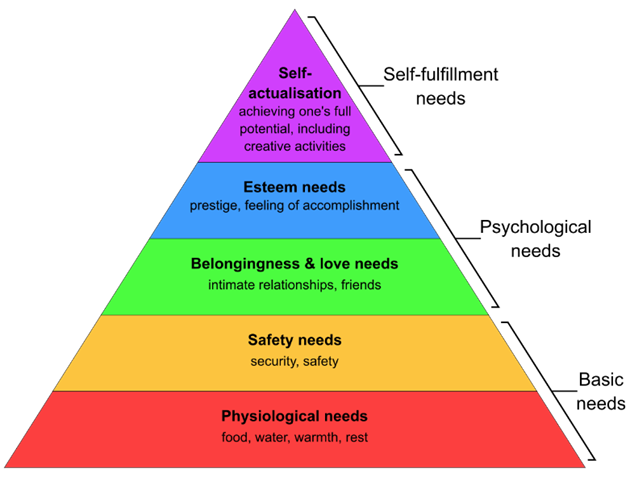
As mentioned above, we are social animals and like all animals we are driven by needs.  We know from nearly a century of research that the brain contains specific circuitry that is dedicated to satisfying these needs from the very basic, like breathing and eating, to more abstract and perilous behaviors like searching for just the right gift for one’s spouse.  The American psychologist Abraham Maslow conceived of a hierarchy of needs as part of a theory to understand human motivation.  This conceptualization divided human needs into three categories: basic needs, psychological needs, and self-fulfillment needs. This is depicted in the figure below. 

Maslow’s hierarchy of needs based on his 1943 paper titled A Theory of Human Motivation.

For the sake of this essay, I will focus only on the psychological needs.  One notable feature of his theory is the importance of friends and intimate relationships for psychological well-being.  We are motivated to form and maintain friendships because they fulfill the need to be connected to a greater social whole which, according to Maslow, is a necessary component to achieving one’s full potential as a person.  That may be true, but aside from a greater goal of self-actualization friendships are also intrinsically rewarding.  Social media capitalizes on this phenomenon by constantly reminding its subscribers how may online followers/friends they have.  A more tangible instance of reward is the gratitude we feel when a friend pays for a drink or helps us move to a new apartment (an act of true friendship if there ever was one).  We also experience reward vicariously when we do something nice for another person, whether they are a friend or a stranger.  For example, I am in the habit of opening doors for women*.  It’s a simple courtesy that makes me feel good.  As mentioned above, our brains are wired for reward.  Rewards motivate our every behavior, whether the behavior benefits oneself, is an act of altruism, or an act of friendship.  The bottom line is that friendships are rewarding in countless ways and are a seemingly essential part of being human. 

*I am aware that some may view this behavior as chauvinist and I have made a concerted effort in recent years to open doors for men as well.

True friends stab you in the front.

-Oscar Wilde

Friendship, Learning and Memory

Two thoughts come to mind when I think about how I have learned from my friends.  The first is that I have often sought friendships with those I admire or who have qualities that I aspire to.  In part, it is though friendships that we are shaped into the people we become.  Friends often set a good example for us to follow.  This is learning how to be.  This could be how to treat others, how to deal with adversity and success, how to listen, etc.  The possibilities for learning in this manner are numerous and often unplanned or unexpected.  I have a friend who appropriates my jokes and funny stories for his own use, and then tells me about it later.  A shared sense of humor is a powerful bonding agent for a friendship.  The point I am trying to make is that the good stuff from our friends rubs off on us (…and sometimes the bad stuff too, but we can blame our friends for that).  Friendships change who we are.  It is also the power of friendship that can give us a glimpse of ourselves through another’s eyes.  This is both affirming and corrective.  Friends are sounding boards that let us know how we are doing in both subtle and not-so-subtle ways.  Friends encourage and support each other.  It is the very best of friends who are unafraid to administer an ego adjustment or tell us when we are wrong.  I think the way we learn from our friends differs from learning that occurs by other means, such as from teachers, books, the internet, etc.  We don’t often form emotional bonds with people we do not know personally or with the various media sources we consume at alarming rates these days.  It’s these deeper emotional bonds that motivate us to listen, to learn, and sometimes to change.  I speculate that this type of associative learning is accomplished by the brain in a manner that is somehow different from other types of learning. 

A second thought is that, through friendships, we learn an appreciation for things and ways of thinking that did not originate from within ourselves.  The interests of our friends become, to some degree, our interests too.  Through our friends we develop new passions and sensibilities.  Through my friendships, I have developed interests in birding, trees, and tennis, to name just a few.  These relationships have also exposed me to the career interests of my friends that I have come to appreciate.  For example, I very much doubt that I would ever have been exposed to the finer points of public land use policy, solid rocket motor construction, and endoscopic spine surgery were it not for my friends.  These are just a few examples of the universe of things that I have been exposed to through friendships.  It is through our friends that we live many lives vicariously and are enriched by the experience.   

There may be some truth to the aforementioned movie line “friendship… might be the only thing you never forget”.  Think about an important memory from your life.  This act of remembering is what psychologists refer to as declarative memory, it is the memory process related to a recollection of facts and events. I really like the word ‘recollection’ in this context because it suggests that the act of retrieving a memory may be a “re-collection” of disparate bits of information to form a familiar narrative event.  We know that certain brain regions, such as the hippocampus, play an important role in this process.  We also know from our own experience (and many decades of research) that these declarative memories are characterized by specific elements.  Now think about that memory again. I’ll bet that your memory of that event contains details about the place, the people, and maybe even the emotions you experienced at that time.  These elements seem to provide a framework for supporting our memories in all their seemingly rich detail.  These elements, such as places and people are critical for these “re-collections”.  There is neuroscientific evidence that the hippocampus contains a dedicated mechanism for remembering spatial information and spatial relationships, suggesting there may indeed be something special about places that is important for anchoring our memories (the discovery of “place cells” in the hippocampus was awarded the Nobel prize in 2014).  I would like to suggest that friends may also have a special role in supporting memory.  Many of our formative and most profound memories are those that include friends and loved ones.  When friends and family gather, they often tell stories about past shared experiences.  It may be this shared narrative among friends that anchors us in time and is part of the critical mnemonic framework that enables us to recall our past.

I have been fortunate to have many excellent and long-lasting friendships.  I think of these friendships often, although it is becoming increasingly rare that I can be with these friends in person.  It is my memory of these friendships that makes me smile and look forward to the next time we are together.  Hopefully by then we’ll have that brain thing all figured out. 

Arrested development.  The author with some lifelong friends in Virginia, 2022
From left:  Gary Lee, Andrew Rossi, Neil Norton, Carlton Stetson

_____________________________________________________

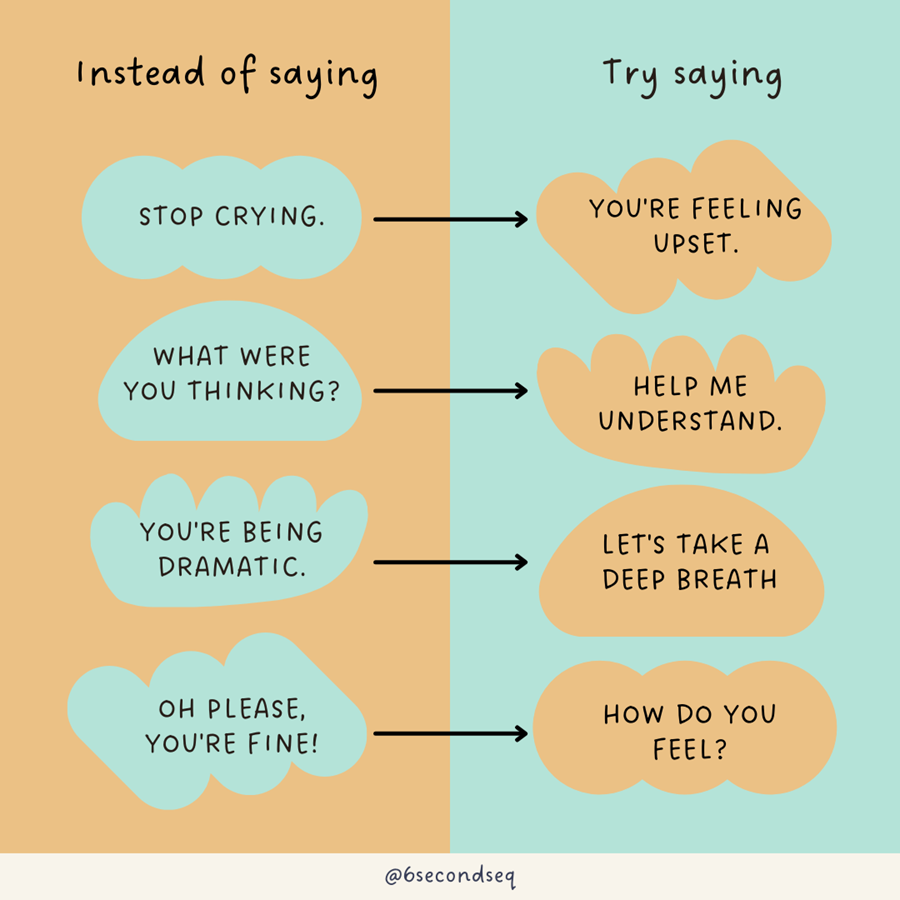
SAYING IT NICER – THIS’ FRIENDSHIPOLGY

Billy – August 2022

Billy passed it on to his good friend, James Luce, and asked for comments. James responded promptly:
 
Hello Billy,
          Here are a few more examples. You can build your own much longer list. Every time you hear a phrase or response that meets the criteria of “inappropriate, inaccurate, incomplete, or mean” just write it down and think about a better phrase or response.
 
Don’t be so stupid!  → Have you thought of the consequences of that plan?
 
You’re wrong! → Please explain to me the facts that support your belief.
 
I hate you! → What you just (said/did) is extremely hurtful and makes me feel awful.
  
OBT, James
 
We can indeed build our own much longer list. This can be a very helpful practice. The idea essentially is “ Be considerate and be empathetic so that we do not to hurt others’ feeling unintentionally.” It helps to think over the words 3 times before passing on any comments – especially judgments. 
 
Billy’s also learned from his late Yale classmate, David McCullough, that President Truman carefully reminded himself not to send out any response immediately when he felt upset. After review the following day he often decided not to send the original message.
 
 
_____________________________________________________


FRIENDSHIPOLOGY THRU MOVEMENT – Qi Gong & Tree Gong – In Unison w/ Nature – by Neil Norton – March 2022

NEIL NORTON  is a Certified Arborist since 2002 and holds a Masters Degrees in Business Administration and Latin American Studies from Tulane University. Neil is passionate and active around issues of tree conservation and education, both locally and nationally. He teaches Qigong and Taichi since 2008. Neil loves inspecting trees, and thoroughly enjoys his encounters with clients and their trees in all the hidden neighborhoods of Atlanta.

We find friends in many quarters, proximity, common interests, school, neighbors, and even on the internet. I often encounter new friends in movement. My friend Billy Lee has asked me to share my perspective on friendship and movement after demonstrating to him some Qi Gong. 

In Qi Gong, an ancient Chinese series of movements, we often discuss different types of learning, whether auditory, visual, and/or kinetic. Perhaps there are different ways of being friends. I know that becoming friendly with someone often has to do with a “feeling”. Love at first sight would be an extreme example. Often there is just something that intrigues you about the other, which could fall into the categories of types of learning. You might like the sound of someone or how they look. Alternatively, you might be repelled by someone on the same grounds. I found that my movement when not paying attention, which can appear quick and intense upsets dogs. I know because they bark at me. What does it mean to be kinetically drawn or repelled by someone?

So much of our language comes through our body. When we move together in unison there is a power and reinforcement that is shared without words. I have always considered myself a kinetic learner, it is a language that comes natural to me. While I have learned to adapt, words have always been a struggle. I enjoy my Qi Gong practice as it allows me to share with others through movement. Often in movement, I find I can be truer to myself and relate more genuinely than through words.

Movement also allows me to align myself with nature that combines both elements of me and nature as reflected in my body. For me, moving in sync with nature means slowing your breathing pattern and coordinating it with my mind and body through gentle movements. When we move with nature, our movement takes on a deeper meaning. Combine that with another person and it becomes reciprocal. Sometimes I practice what I jokingly call Tree Gong, a type of Qigong with a tree, where I slow my breath and stand like a tree, envisioning your exhalation of carbon dioxide and inhalation of oxygen, exactly inverse to what the tree is doing.

While movement most always starts internally, it is always expressed in an external fashion. Some types of movements are more accepted than others, for example tennis on a tennis court, or frisbee on a field, or dancing in a club. The ancient arts, like Tai Chi and Qi Gong, not only connect us with those of past, but it is also an excellent way to connect with those in our present. There have been several occasions when I attracted unwanted attention practicing Tai Chi in public.  So, finding a safe place to practice is important, unless you are trying to make a statement, but do not be surprised if the statement is misinterpreted or worse is threating to someone.

Many feel constricted by their ability to move, whether it is emotional or physical. Each of us has our own ways to move through gravity on Earth. We are nature, each one of us, so embrace a method and do not judge yourself, just breath and move. The next time you see a movement practice, whether dance, tai chi, qi gong, throwing the frisbee or playing ping pong, consider partaking. There is power in moving together and in unison with nature.

_________________________________________________________
Billy’s Comments :

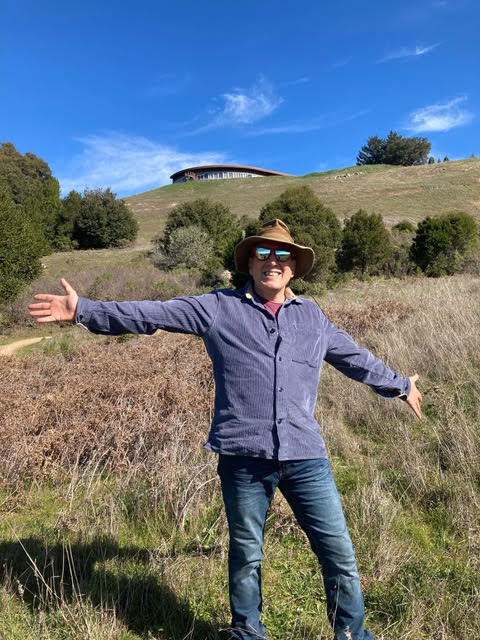
Neil is one of my son, Gary’s very best friends. They grew up together in Ladera as neighbors and schoolmates when they were near ten years old.  I was an active participant in many of their sports activities. One year, Neil got injured and could not play baseball for quite a period. He and I got to know each other and became friends as we watched and cheered for his teammates and had many fun and interesting conversations.  Neil and family visited us earlier this year from Atlanta, Georgia.  I invited him to write for this Friendshipology Website.  Thanks, Neil, for adding “TREE GONG” in our vocabulary.

__________________________________________________________

What Do the Following Fraternal Twins Have in Common with Alice’s Restaurant — by James Luce

Yi Qi and Male Bonding
East and West
Syntax and Semantics

– 20 Feb 22

(Before proceeding, you will find it useful to first read Stephen Lee’s entertaining and informative article about Yi Qi that is posted on this site.)

As I’m composing this essay, East and West are just barely balancing on the verge of WW III. The US/EU could go to war at any time with Russia, China, North Korea or all three. I hope you are reading this essay in peace.

The question in the title of this article came to mind as a result of having read and discussed a draft of Stephen Lee’s article about the meaning of Yi Qi (righteous loyalty), its ancient, complex, and fascinating philosophical/linguistic origins via the transmogrification and malleability of Chinese characters, concluding with a discussion of Yi Qi in China today. Stephen notes that there are seemingly coincidental similarities between manifestations of Yi Qi and what in the West is called Male Bonding.
For example, Chinese tales of the mythical folk hero warrior, Guan Yu, extol the virtuousness of truly righteous loyalty, the warrior standing by his fellows in danger and never betraying them to the evil enemy. Stephen notes that there’s also a sinister side to Yi Qi as represented by the 108 Outlaws of the Marsh. These folk heroes stole from the rich and gave to the poor, similar to the Western myth of Robin Hood and his Merry Men. The difference between these two gangs being that The Hood bunch returned to the Nottingham people the money stolen by the local aristocratic crowd from those same people, whereas the Marsh bunch gave the money they stole from the aristocrats to poor people who had not necessarily been the original victims. Thus, The Marsh system was not as efficient or equitable a redistribution of wealth scheme as perpetrated by the Hoods. However, both involved the commission of many violent felonies.
The West has many examples Yi Qi/Male Bonding that are not remotely pure, righteous, good, or productive. Butch Cassidy and the Sundance Kid are two loyal buddies gone bad…sticking together through adversities of their joint making and dying side-by-side in a hail of retributive bullets. Another, larger, example is The Wild Bunch. These four dastardly desperados didn’t have a shred of the Cassidy/Kid humor and joie de vivre. Not a bon mot between them. Neither of these two gangs gave any of their stolen loot to any poor people, keeping it all for themselves. Yet they too are folk heroes because of their devotion to Yi Qi. And then, of course, there’s the Mafia, American folk hero murders and extortionists simply dripping with Yi Qi and blood.
In modern America the ideal of Yi Qi in all its variations is robust. Every extreme is represented, from fraternal charitable organizations (pure) to drug cartels (toxic), with political organizations (dominated by male bonding) located somewhere in between those poles. Thus, it’s clear that it’s really not just a coincidence that China’s Yi Qi is paralleled in the West with Male Bonding. It’s not a coincidence because, after all, we’re all humans. Our ancestors faced the same problems and mysteries, few of which have been fixed over the millennia. The difference today between each of us and between our cultures is simply a manifestation of different routes to failed resolutions of our common problems and mysteries.

Welcome to Alice’s Restaurant!

Arlo Guthrie’s Alice’s Restaurant, released in 1967, is the generational anthem for most War Babies (1939-45) and Baby Boomers (1946-64). The first seven minutes forty-two seconds of this song are about Arlo’s adventures in Stockbridge, Massachusetts: Thanksgiving dinner at Alice’s restaurant and his subsequent arrest and trial for littering and creating a nuisance…but that’s not what he came to tell you about. He spends the remaining ten minutes fifty-seven seconds singing about the Military Draft, a very hot topic during the Vietnam War. I’ve started out talking about Yi Qi. Here’s what I really came to talk about: The Roots of our Common Humanity and the Routes we need to collectively take so as to reacquire our Common Humanity.
The primary focus of this essay concerns how to restore harmony among and between the bitterly splintered factions of our originally Common Humankind. These factions we usually refer to as our myriad cultures, nations, economies, minor genetic variations, languages, philosophies, religions, and other artificial, antagonistic, and divisive instruments of civilization. The original humans fought over food, water, and basic survival. In today’s world we have dozens of more things to fight about, most of which have nothing to do with food, water, or basic survival: patriotism, politics, beliefs, irrational prejudices, languages, and cosmologies. What could be more idiotic than to go to war or start a bloody riot over skin color, a flag, a political party, or especially those variable cultural answers as to where we all came from originally and why. “Especially” because nobody really knows and probably never will.

So…Let’s talk about just one of these splintering factions, the least likely to stir up patriotic or cultural animus: Languages

My father and his three older siblings were China-born, children of a Presbyterian missionary in Shandong Province during the disarray of the prolonged warlord period. When I was a very young child, I remember that my now grownup Aunt Beth hung embroidered towels in her New York apartment that read East is West. It was not until several decades later that I began to understand this cryptic message. We will return to this theme shortly, but first…

There’s a traditional belief/stereotype among Westerners, Anglo-Americans especially, that the Chinese people and their language are inscrutable. Well, what does that mean? The dictionary says, “impossible to understand or interpret”. So, perhaps Americans criticize the Chinese because Americans aren’t intelligent enough to understand what is being said or written in Chinese. In turn, Chinese people traditionally believe that Americans are blunt, both in language and mind. So, perhaps Chinese people criticize Americans because our dominant language, English, is, for the most part, direct and blunt and, well, plain ol’ Anglo-Saxon…avoiding ambiguity of meaning whenever possible. Or perhaps there’s another explanation for these stereotypes.

The source of these cross-cultural stereotypes is most likely the syntax and semantics of their respective languages. If Yi Qi is translated as “righteous loyalty”, that’s inscrutable to an American. But if it’s translated as “male bonding”, there’s no problem.
Let’s see which language and which culture is more inscrutable by comparing two quotations. Which of the following quotations was written by a Chinese scholar and which by a Western scholar:

A man is never too old to learn.
vs.
A man is never too old to set another goal or to dream a new dream.

Both of these aphorisms have a similar message, but one is blunt while the other is a bit fuzzy. So, it may surprise that the first quotation was written by an anonymous Buddhist scholar several thousand years ago and that the second is by the famous British scholar, C.S. Lewis.


Which of the following quotations is more inscrutable?


What is the sound of one hand clapping? (an ancient Buddhist riddle)


If a tree falls in the forest when nobody’s around, does it make a sound? (Bishop George Berkeley, a 17th-century Anglican)


They both seem inscrutable to me. Well, maybe these aren’t representative samples. Maybe Eastern thinking really is more inscrutable than Western philosophy. Let’s start out in neutral territory, somewhere neatly in between East and West: Ancient Greece was influenced by Egyptian, Iranian, and Chinese scholarship that flowed along the Silk Road and other trade routes. Our neutral thinker of choice is that famous pagan Plato. He postulated that physical objects and indeed the entire observable universe was nothing but shadows of True Reality (what he called Forms) that we mere humans could never see or experience.
Returning to Bishop Berkeley, who goes Plato one better, we find that this inscrutable Western Christian scholar believed in Immaterialism, a philosophy that denies the existence of all material substance. That is, all objects and indeed the entire observable universe exist only as ideas in our minds. If we don’t think about something, it doesn’t exist. There is no reality at all.
Let’s now compare, using the inscrutability scale, these two Western philosophers with their ancient Chinese counterparts. Several thousand years ago in pre-Buddhist China, philosophers thought about the Dao. The Dao is an ultimate source that connects all things and the entire observable universe. Everything is real, tangible, observable…no Forms or shadows or ethereal existence-only-in-the-mind. Rather the Dao is a Way or Guide that is observable, accessible to cultivated people who have the leisure time to contemplate it. In this real world, patterns can be detected, cyclical patterns that interact between the polar forces of Yin and Yang. Yin is a symbol of earth, femaleness, darkness, and passivity. Yang is a symbol of heaven, maleness, light, and activity. While these distinctions are offensive to our modern Western views, they match perfectly with how both Westerners and Easterners have divided things up for millennia. Furthermore, traditional Chinese philosophy at least acknowledges that water is wet, rocks are hard, a chair can be sat on…in short, the world exists in reality.
We can see that in the Pre-Science Age, the Greeks, Chinese, and Europeans postulated a similar answer to a shared mystery. Yet it was the Chinese solution that is the least inscrutable.
But what about modern times? Is the situation different now? Only slightly. If you read the modern Western philosophers, you will note extensive incorporation of Eastern ideas from the Dao, Buddhism, Islam, Jainism, and even some of the Hindu scripts. Reading modern Chinese philosophers, one finds substantial bits and pieces of Kant, Hegel, Marx, Nietzsche, Bergson, Dewey, and Heidegger.
Ahhh. But then there’s those ambiguous scribbles called Chinese characters that they use for writing. Not like good, clear, alphabet writing with just a few, easy to write and type letters. Certainly this makes English less inscrutable than Chinese…or does it?

Here’s a simple, plain, typed-with-letters sentence in English. “As a linguist, I love ambiguity more than most people.” See? Clear as a bell, sort of. This sentence could mean that the linguist “loves ambiguity but doesn’t appreciate most people” or that “most people don’t love ambiguity as much as he does”.
Well, perhaps Anglo-Americans can at least take comfort in the fact that English words are clear, unambiguous, and never inscrutable. Except maybe just a few, such as the word “sanction”. Even though this word is typed clearly with letters, “sanction” can mean either approve or disapprove. Compare with those Chinese scribbles. Approve: 批准 could never be confused with Disapprove: 不赞成. And then there’s flammable and inflammable. Both mean capable of catching fire. The list of inscrutable English words is almost endless, if not also eternal or infinite. To conclude with a good, clear Western question…If waves really exist, where do they go when they reach the beach?

继续我们的旅程

The above process of analyzing languages can be applied also to all the other previously mentioned factions of civilization that divide our Common Humanity, but such a detailed analysis is beyond the scope of this essay. Very briefly, all the philosophic, linguist, religious, and other cultural artifacts and variations extant today are just a dense, swirling fog keeping us from seeing that we’re all just humans trying to figure out how to stay safe in a dangerous and confusing world…and once safe, how to get along in peace. All the past and present isms of religion, politics, and philosophy are just failed and conflicting experiments. We are bungling alchemists in a universe based on cold and uncaring physics.
We are all humans, evolved from the same genetic mixture that uniquely gave us an opposable thumb and an immensely intelligent brain, a brain that learned how to use the thumb for more than climbing trees and gathering fruits. We’ve used our thumbs and cumulative knowledge to build and to destroy; to make war with technological gusto and diligence; to strive for peace but neither sincerely nor successfully. Humanity gets an “A” in the course of evolution for our millennia of effort, but a C- for achievement. We are still ignorant children playing with fire. The time left for us to grow up is perilously short.
No one culture, no nation, no person is passing the course. We need to give all others a break. Stop the chest thumping, stop the celebrations of our respective failed experiments, and get back to the difficult task of studying, striving to find better ways to achieve harmony and to solve all our common mysteries.

Now back to Aunt Beth’s embroidered towels… “East is West”

East is West

Like a maze when first encountered, all of Humankind’s myriad, eclectic routes through life over time and place appear jumbled, confused, and divided into many paths. Yet on closer examination, there is continuity, harmony, and a common goal. The maze is not made of many parts, rather, like Humanity, it’s an indivisible unit, a living organism thriving in the same soil under the same sky. Viewing the maze from above is much different than from on the ground. An individual can’t see that there’s a common goal when inside the maze, rather only the varied pathways. Most of the paths are dead ends.

The trick for Humanity is for everybody to harmoniously help to find the correct route to the common goal.

OBT, James

End Notes
Sino-American stereotypes: https://immi.se/intercultural/nr42/zhu.html
You may listen to the song and read the lyrics of Arlo Guthrie’s, Alice’s Restaurant at, respectively: https://www.youtube.com/watch?v=m57gzA2JCcM

and https://www.google.com/search?q=alice%27s+restaurant+full+lyrics&rlz=1C1RXQR_esES973ES973&oq=alice%27s+restaurant+full+lyrics&aqs=chrome..69i57j0i22i30l2.14811j0j15&sourceid=chrome&ie=UTF

__________________________________________________________