Have you ever had that as an angry response to something you said? If so, did it immediately occur to you that the other person had heard what you said, but not at all what you meant?
Friends (and patient people of all types) tend to respond to tough moments with questions rather than statements.
“Are you saying…?”
That is a move that shows a willingness to be humble (we don’t always understand what people are saying), and a caring for the other (we want the other person to know we won’t jump to problematic assumptions).
It’s a simple thing, but can do much to strengthen relationships.
Another way to look at “I can’t believe you said that!”, though, is to consider a scenario in which someone has just been blown away that you were able to say something in another language that the listener wouldn’t have guessed you could.
Everyone understands that a prerequisite for human friendship is some ability to communicate, and typically by language.
If we look at learning another language (Mandarin for English speakers, or vice-versa) as a good example, one might consider what it means to make the leap.
Two years ago I began studying Mandarin using YouTube videos, podcasts, and the free Duolingo app. I was intrigued by the challenge of learning another language for free, and as I already am pretty good at Japanese, I figured the characters wouldn’t be an impossible barrier to overcome.
Fast forward to now, and I’ve had a blast picking up things I can try out with my Mandarin-speaking friends. They encourage me, and their smiles when I get the tones right is something I treasure.
The effort is something that strengthens my relationships, and gives me a feeling of empowerment. What will I try saying when I see my friends next?
Whatever it is that helps you develop more patience and empowers you, give it your time. It might serve as a new avenue for strengthening your friendships.
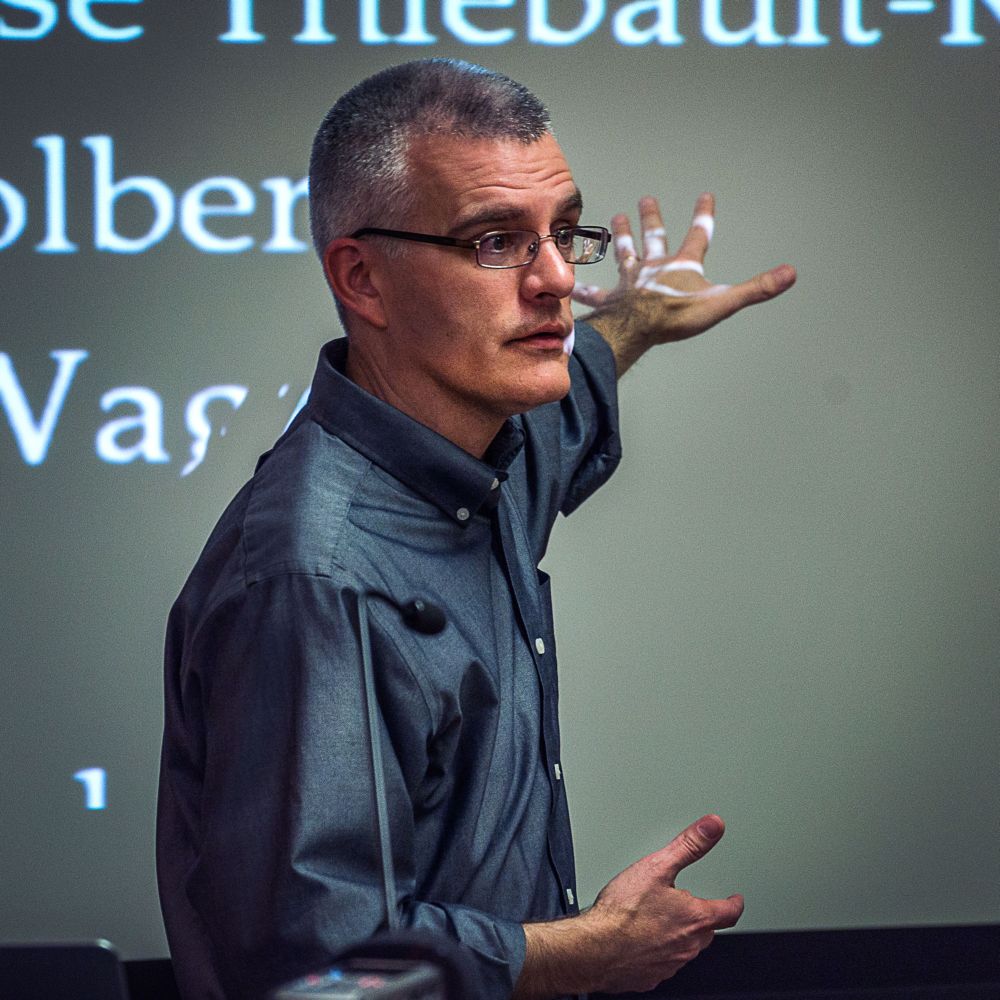
Rushton Hurley is a former high school teacher, former principal of an online high school, program director at the Krause Center for Innovation, and founder and executive director of the educational nonprofit NextVista.org. Rushton has spoken to and trained over 100,000 teachers and school leaders around the world over the last decade, on topics such as professional development, school improvement, change strategies, staff morale, promotion in the community, and getting the best out of students and teachers.
Brother Depai: Our friendship is built on the mutual understanding that has been piling up day after day. Since I got the news that you are leaving, everything about me feels not normal. What can I say under this dazed emotion? Okay, you ask that I write something useful ! (1) Don’t think that we must be perfect people to be friends. Of course, everyone has his strengths and weaknesses. We can learn from the others’ strength and help mend the other’s weaknesses. Should we not do that ? (2) People should not do improper things. Even if our best friend does something wrong, we can not just relax him. (3) We should not always talk about other people’s shortcomings, but should tell them what we know. (4) Don’t be too confident or too proud. For example, in playing chess. If your opponent is someone new to you, be willing to lose a few games to him. The above, Depai, are all the things you have told me. I think they are truly precious. How many times can people hear such honest and frank advice in their lives? There are many more valuable words I do not remember. “Write something useful” you say. Okay, let us encourage each other at least with these few words.
Brother Depai: The news that you are going to Hong Kong makes me sad. Classmates for so many years, we have unspeakable feelings. Do you remember us talking and laughing together? Do you remember the joy of playing ball and reading together? Did you find that we were the happiest people? Now you are going. You are leaving us lost without fire. Know the pain of human beings without fire. I don’t know how to describe it. Your going will make me less happy than before. I have now lost a comrade with whom I pursued knowledge together. I now only hope that I can go to Hong Kong and learn with you again. Together enjoy the infinite joyous life. Ah! A-Kan! Wait for me, and I will go to Hong Kong to find you.
Now, here are a few words that we can encourage each other: You are an innocent and lively youth, full of justice in your mind, and you are extremely smart. You are friendly and sociable. People seem to want to be close to you. This is your benefit and your success factor. Hope you keep it. You also have shortcomings. You often say that people should not be too arrogant or too confident. This is idiotic. Often you seemed to be lacking self-confidence. Of course it is not good to be overly confident, but it is also not good to appear lacking in confidence. A great man’s success is due to his ability to balance self- confidence with humility. Thus he will stand out. With your smartness, you can overcome all difficulties. Don’t lose your self confidence.
DePai, My Friend, Your news came too suddenly. I didn’t expect our normalcy be disrupted like this. For several years, we have learnt and played together, and then we got to know each other. Now fate pulls us apart so abruptly. Do you remember the joy of laughing together, playing ball, and studying together? This will be our most beautiful memory. I hope you don’t forget it.
Your leaving causes a big blow to my heart. I realize that I will lose a friend with whom I have studied together thtough out my middle school years, . I feel infinite emptiness in my mind, now. What can I write for you in this booklet?
Your parting makes me envious, because you will be first to leave this small mountain country to come into contact with a broader life. I envy you that you can see the unprovoked ocean. But be careful: the more civilized the place, the more evil it maybe. I hope you will be careful every step and be on guard. When you fall into the abyss, I will regret that you are the smartest of the people I have met. I hope you can use your wisdom to enrich your body and mind. Don’t be smart and mistaken. You have a kind heart and a gentle attitude. You can get along well with anyone, and this is your admirable trait. You also have shortcomings: you lack self-confidence. Of course, it is not good for people to be too confident. But it is even worse if they are not self-confident. There is a well-known saying that “ people who lose confidence in themselves will not be able to accomplish anything in the future.” That’s dangerous, I hope you can correct that. Also, you don’t pay enough attention to small things. For example, someone asked you to do something, and you often forgot to do it. Although this is a trivial matter, it will affect your credibility. I hope you will pay attention.
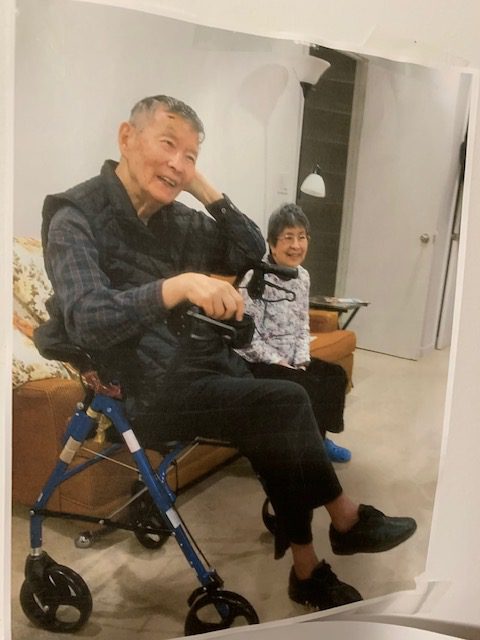
I was born in China. We as a family lived in Hong Kong when the Second World War started. We went into China in 1942, staying in Guilin and Kunming until 1949. We came back to Hong Kong in 1949, and went to the United States in 1951. I went to Brooklyn Polytechnic Institute for my undergraduate and M.I.T. for my graduated school. I became a Christian while I was in M.I.T.
My objective in life is to serve Jesus Christ in whatever ways God leads me. Lately it is the distribution of good music with a message through the Internet. God has also provided me with the means to fund His work through a charitable trust.
Seventeen years ago, when I was 70 years old, I thought that my life was going to end. I came to this conclusion because in Psalm 90, a psalm written by Moses. He said that a man’s life is about seventy, but if he is strong, eighty. I thought that since I was not strong, that was my life. Thank God He has given me seventeen more years to live.
I was married to Sylvia Fong in 1961. We have four children, Elizabeth, Sarah, Paul, and Samuel. Thank God they are all Christians.
George and I have been friends for nearly 60 years. I remember him trying to introduce me to Christ in the early 1960s by taking me to listen to the famous Billy Graham at the NYC’s Madison Square Garden. Despite of George’s continuing efforts, I have remained an Agnostic with a touch of Buddhist attitude. Only recently, we discovered that we have a very different take on Donald Trump, but we, indeed, still have deep respect and affection for each other. I asked Geoege for permission to post these precious PARTING WORDS from his old high school mates on this special Friendship website. He said “YES” without hesitation. BTW, this tradition of asking friends to write a few meaningful Parting Words is so good for validating, enhancing, and forever sustaining GOOD FEEELINGS among Friends. We should encourage that as a global tradition, indeed ! Thanks, George !
I joined the USCPFA-S.Bay Chapter in 2006, and was elected Membership Director in 2012. That started my serious inquiry on what Friendship really means, and how it can be initiated, nurtured, sustained, and maybe recovered after some gross misunderstanding. I started to do some research by reading books and by Googling.
I also wrote a few articles which were published in Women of China magazine, as well as Voice of Friendship, a publication by China Friendship Foundation for Peace and Development. I was particularly interested in promoting Home Stays in Building Cross-cultural Bonding.
In 2015, I was invited to conduct a workshop on “Good Feelings” at the ICAF World Children’s Festival on the Great Mall In Washington DC, on a July 4 weekend. There sprouted the idea on guiding a group of International students to Define Friendship, Write an Declaration of Interdependence, and Propose an Ideal Cross-cultural Institute on Friendshipolgy.
An amazing opportunity to start a project that may eventually lead to the Ultimate Ideal was a proposal to connect Stanford University’s and Peking University’s psychology departments to do a 3-year joint research project at both ends of the Pacific. The study was named “ The Role of Emotional Values and Expression in the Development of Cross-Cultural Friendships in the US and China “ Our hope was this would initiate a Momentum towards Global Engagement subsequently. I like to take this opportunity here to thank publicly, Prof. Jean Oi ( Director of Stanford Center at Peking University ), Dr. Jennifer Choo ( Assoc. Director at Stanford University’s Walter Shorenstein Asia-Pacific Research Center), and Prof. Jeanne Tsai ( Director of Emotion Lab. at Stanford’s Department of Psychology ) for their tremendous efforts.
Although that proposal fizzled due to fund-raising difficulty, my dear 1990 Institute colleague. Dr. Marsha Vande Berg, advised me to keep telling this story to my friends – To keep the Idea alive ! Surprise ! Out of the Blue, a young friend, Yi-lu from Beijing, wrote to me and said she had set up a website https://MingSingLee.com ( recently changed to https://Friendshipology.net ), and had recruited three other young friends ( Yihua, Wenmo, and Tingting ) to help me promote FRiendship and to manage this bilingual website. She said that she was moved by one of my articles stressing “ Not to judge people too harshly and absolutely. Try to cultivate others’ Good Qualities and Goodness, as well as our own. “. I started first to post a few of my own articles onto the website but very wisely decided later to involve many of my close friends.
Yesterday marked the first anniversary of this Friendshipology website, and the week before I started to review all the 77 articles I had so far collected – to examine ‘What Lessons Learned and What’s still Needed . Thanks to all of my friends who have so generously given their time to support this effort, I myself learned quite a lot from these friends on various aspects of Friendship and Friendshipology. Most importantly I feel that our friendships have deepened from this sharing, and I am truly happy and grateful. I am also glad that I was able to connect a few friends who apparently share same high aspirations. I hope that they will be able to collaborate together when opportunities allow.
From the review I noticed that several friends focused on Gratefulness in Receiving and Gratification in Giving , few on how best to treat people, one was angry and unforgiving, and another Critical of Society and Cynical. Most covered the rosy aspects. I will indeed welcome more stories on awkward situations, recovered or not recovered, or just thoughts on how it might be recovered. I welcome more descriptions on specific, big or small, kind or thoughtless, deeds which I think younger people can readily learn something immediately useful. I welcome more stories on how Community Spirit effects Individuals and how Individuals can effect the larger Community. Stories on Connecting and Helping others to Connect will be most helpful. Can we learn more from each other about, Attitudes, Listening, Timing, To say the right words or When to be silent, etc. etc. ? I am hoping to collect more Case Study type examples that can be ”Inspirational” and/or “Educational” or “Provocative with Good Effects”, and Ideas on how to set up the proper environment or activities etc. to induce Friendship, Bonding , and Good Feelings.
Please participate in this effort and share your knowledge, experience, and ideas on this Friendshipology website. I can be reached at WilliamMSLee@gmail.com. With your article, please provide a short vita and at least one of your favorite photos.
Thank you !
Gratefully yours,
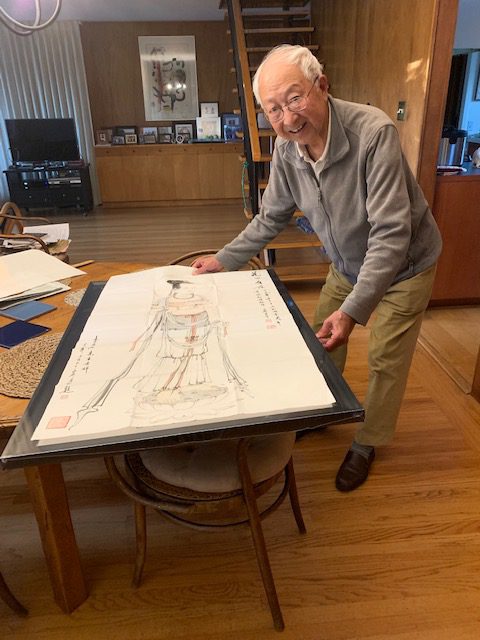
William ( Billy ) Ming Sing Lee 李名信 ( 88 yr-old retired Architect ) 271 West Floresta Way, Portola Valley, Ca. 94028, U.S.A.
When Billy asked me to write about “friendship and poker”, something Warren Buffett has said immediately popped into mind. Buffett has offered this advice on friendship for years, “You will move in the direction of the people that you associate with. The friends you have will form you as you go through life. Make some good friends, keep them for the rest of your life, but have them be people that you admire as well as like.”
“So it is important to associate with people that are better than yourself.”
Much on friendship has already been shared on Billy and the World. It is rather imposing when asked to contribute to a platform with a stated mission “Search for Essence in Knowledge and Goodness”.
The Essence:
Friendship with peers better than yourself sounds great if it does not involve poker. Poker is all about winning your hand, friendship with better poker players is great in concept but terrible in execution.
Another widely quoted Buffett, “Price is what you pay, value is what you get.” For investment, this is great insight for those seeking value-oriented long-term investment. For poker, “Multiple buy-ins are what you pay, low self-esteem is what you get” when you are up against better players, especially if with friends.
Bottom line, friendship and poker do not mix well.
Knowledge &Goodness:
Knowledge and Skill are overrated. Thank goodness there is an element of luck in poker. Treasure luck over skill any day, any time and with that friendship still stands a chance.
He stopped playing tennis for 15 years and is now playing catch up for lost time. Tennis four days each week is great if the head, shoulder and knee all cooperate. Monday is always slow, take until Wed to warm up and by Friday it’s time to go easy and relax. The cycle repeats.
His profession as a real estate developer came late but sweet while it lasted. Nothing perfect, but at the least was conducted like a symphony, as it should be for any complicated project to be successful.
The work force multifamily housing project as a public/private partnership in San Mateo is a first for the City. The technology office/residential campus at the BART mass-transit station is a first for the City of San Leandro. The entitlement and adaptive reuse of a blight neighborhood center into school for the Foster City San Mateo School District is a first for Foster City. Demographic data mining and use of geographic information systems in real estate analytic is pioneering and ahead of its time and popularity. Last to be mentioned but most proud of is the acquisition and installation of the 55 foot Burning Man sculpture “Truth Is Beauty” at the tech campus.
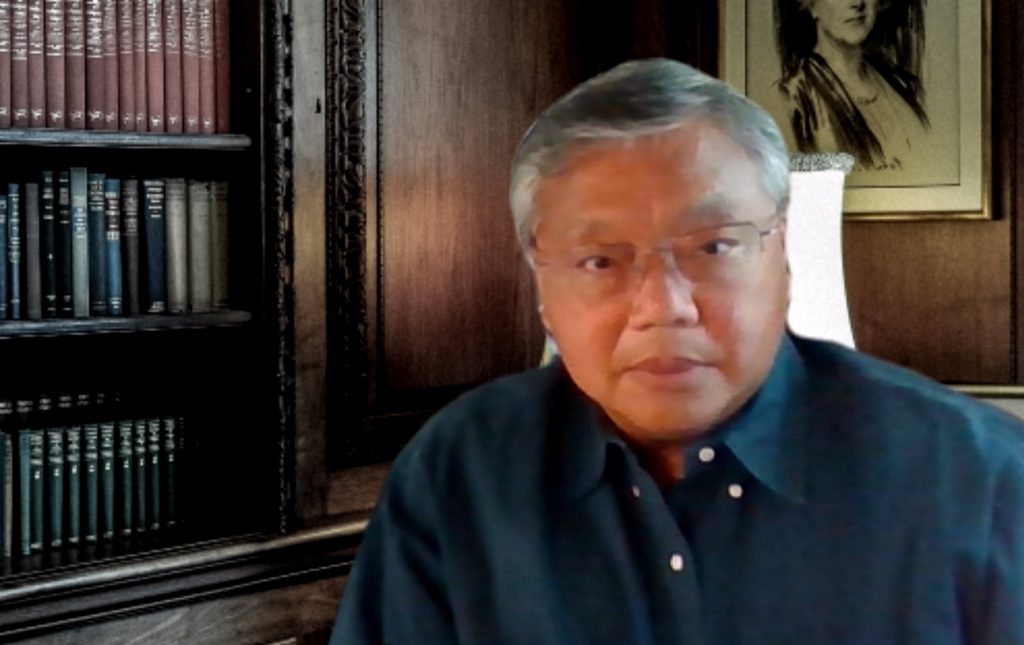
Harry is currently a Realtor with Compass in Palo Alto, California, and loves what he does, especially since he works with his best friend, Charlene – who also happens to be his spouse and life partner. Prior to real estate, Harry had a fruitful career in finance, consulting, private equity investments, and corporate management. He left his last role as an Executive Vice President of Li & Fung in 2015, because he had promised Charlene he would leave his globe-trotting job when his younger child left for college, and he kept his promise.
Harry has been in the Bay Area since 1988, when he transplanted from New York to attend Stanford Business School. The sunny climate, the great outdoors, and the diversity of people and cultures served as strong draws to keep him here, and he hasn’t looked back since. In addition to work, Harry volunteers his time with various organizations, including serving as Chair of the San Francisco Lodge of FF Fraternity, the oldest Chinese fraternity in the US, and interviewing for Yale College and Phillips Academy. Harry is a former Director of Yale’s alumni interviewers for the Peninsula region and was a founding Board member of the Association of Asian American Yale Alumni.
Most of us have more than a few good friends. We enjoy each other’s company, having nice meals together, playing games, and oftentimes having thoughtful discussions. Sometimes we help a friend through a difficult time – parenting problems, issues with a spouse, or an illness. During these rough patches, friendships can grow deeper as we offer comfort, love, and support to our friends in need. There are other times when our relationships may hit some turbulence and we avoid talking about the cause of the rough air. My proposition in this posting to Billy’s friendship website is that rather than avoiding the bumps, making the choice of engaging in difficult conversations can deepen the bonds of a friendship or other relationship that may be meaningful to you.
I would like to share two personal examples:
A long time ago when I was a second-year business school student, I was in a class that included a time-consuming group project, and everyone in the group received the same grade on the project regardless of individual effort. One of my very good friends was a member of this project group and he usually came unprepared to our meetings and hardly did any work. One of my core values is to be fair and considerate to others, so I felt strongly that my friend was being extremely inconsiderate of his fellow group members. This feeling steamed inside me throughout the quarter, yet I didn’t do anything about it. Finally, at one of our evening meetings, I called out my friend for his lack of preparation. I tried to talk in an objective manner and voiced my feelings, rather than attack my friend, but it still was a very strained discussion. To my friend’s credit, he pulled me aside after the meeting to talk further and we ended up talking for a few hours until well after midnight. It was definitely not an easy discussion – we were NOT shooting the breeze – but we ended our talk with a tight hug and not only did we remain friends, our friendship got stronger as a result of this difficult conversation.
My second story is both work-related and personal. My boss (who also was and is a good friend) and I had to endure a very challenging stretch at work, commuting weekly from the Bay Area to New York for a few months, as we were trying to save a company from bankruptcy. During this time, we were eating breakfast, lunch and dinner in the office, oftentimes returning to our apartment in the early morning hours. Adrenaline was high, as was stress, and morale was very low. Towards the end of this difficult assignment, I wasn’t feeling great about my relationship with my boss, because he wasn’t communicating like he normally did, he was curt during our discussions, and he just seemed angry with me. Under the circumstances, I didn’t blame him at all, but because the tension between us was bothering me, I finally broached the topic over a late dinner. I tiptoed into the discussion, because this was definitely a sensitive situation, but I was clear in my intention and I voiced how I felt. My boss didn’t hold back and laid out exactly why he was upset with me; the tension between us was definitely real, not imagined. For what seemed like a long time, we talked about our respective feelings and our own perspective on the situation. At first, the tension was as thick as the spicy curry sitting on the table, but in the end the air was clearer and the haze had lifted. We understood each other and we respected each other’s perspective. Instead of letting this tension simmer and fester, and hurt our relationship, we talked through this difficult and sensitive issue. The result was a stronger, not weaker, bond.
I’ve had a few other tough discussions, not just the ones above. I like to share a few lessons learned from my experiences with difficult conversations:
Confront difficult situations, don’t avoid them. For many of us, the easy thing to do is nothing, but avoidance doesn’t resolve differences and, more often than not, simply makes the situation worse. Whatever bad feelings there are will fester and, without meaningful dialogue, both parties just think the worse of the other. Inaction causes a self-fulfilling prophecy, because our negative thoughts fill the communications vacuum.
Difficult conversations don’t need to be confrontational. Take your emotions out of the equation and conversation, understand the other person may have a different perspective, and respect that other perspective. A lot of times when we go into these tough discussions, we go into attack mode, thinking we’re right and the other person is wrong. This mindset will just make matters worse, so don’t do it.
It’s okay to allow yourself to be vulnerable. Share your thoughts, your perspective and, especially, your feelings. Instead of labeling or judging the other person’s actions, talk about the impact of those actions on you. There’s no right and wrong, or good and bad, about how you feel, but when you say something like, “What you did yesterday was bad,” you immediately put the other person on the defensive.
Focus on a mutual understanding of the issue, and move the conversation towards a resolution that meets both persons’ needs. Remember that your goal isn’t to simply “get the issue off your chest,” but to work together with the other party to reach a meaningful (it doesn’t necessarily have to be amicable) resolution.
From my personal experience, when I’ve engaged in difficult conversations with friends, our bonds got stronger and the relationships became more meaningful. On the work front, difficult conversations have resulted in mutual respect and understanding, and a tighter team mentality. So when you’re confronted with a tough situation, think twice before you turn your back on it. Dealing with controversy and sensitive situations proactively and with purpose will strengthen your relationships, both personally and work-wise.