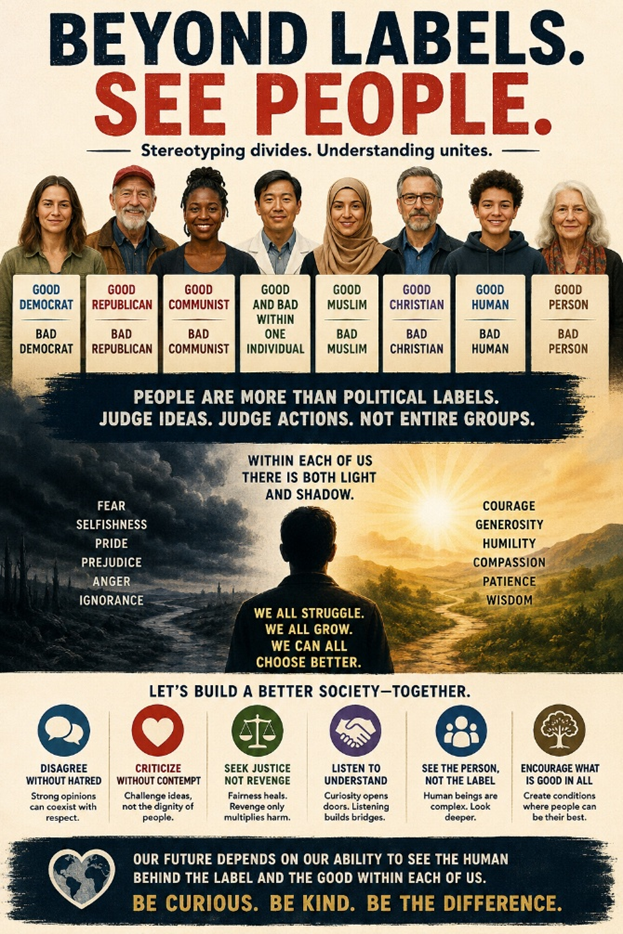
ChatGPT: That is a deeply important observation.
Human beings are rarely one-dimensional. Political labels, nationalities, religions, professions, and ideologies can describe tendencies or affiliations, but they do not fully describe character.
There are compassionate conservatives and cruel conservatives.
There are wise progressives and reckless progressives.
There are generous wealthy people and selfish wealthy people.
There are caring revolutionaries and destructive revolutionaries.
And within each person there is often a continuing struggle between fear and courage, selfishness and generosity, pride and humility.
Stereotyping becomes dangerous because it simplifies living human beings into symbols. Once people become symbols, conversation weakens, empathy shrinks, and hostility grows. Entire groups are then praised or condemned as if all members think, feel, and behave identically.
History repeatedly shows the cost of this:
- political demonization,
- racial prejudice,
- religious intolerance,
- class contempt,
- and ideological fanaticism.
Very often, the healthiest societies are not those without disagreement, but those able to preserve:
- disagreement without hatred,
- conviction without dehumanization,
- criticism without contempt,
- and identity without tribal blindness.
It is also insightful that you mention “good and bad within one individual.”
That may be the most realistic observation of all.
Human character is dynamic. A person may be generous in family life yet harsh in business. Someone may defend justice publicly yet fail privately. Another person may make serious mistakes and later mature into wisdom and compassion. This complexity is part of being human.
Many philosophical and spiritual traditions recognize this inner duality:
- Confucian self-cultivation,
- Buddhist awareness of attachment and compassion,
- Christian struggles between sin and grace,
- Islamic emphasis on inner moral striving,
- Greek ideas about virtue and appetite.
Healthy culture therefore depends not merely on “defeating bad people,” but on encouraging conditions that bring forward the better side of human nature:
- good education,
- honest dialogue,
- meaningful work,
- art and music,
- stable families,
- fair institutions,
- friendship,
- and opportunities for redemption.
Perhaps one of the wisest cultural habits is this:
Judge ideas carefully.
Judge actions fairly.
But be cautious about judging the total worth of entire groups — or entire persons.